 BBELC
BBELC
Isolation Transformer Vs Step Up & Down: Key Differences
56Discover The Key Difference Between Isolation Transformer And Step Down Or Up Models To Prevent Equipment Failures.
View details
Search the whole station
It is not difficult to find a list of the top power transformer manufacturers in 2026. As expected, Hitachi Energy ranked first worldwide, followed by Siemens Energy and GE Vernova. Looking at the U.S. market, prolecge and Virginia Transformer are the safest bets for stabilizing domestic production. In Asia, TBEA and China XD Group are setting benchmarks for export-ready Chinese manufacturing.
However, just knowing the name will not save your project. The actual nightmare of keeping EPC contractors awake now is the shocking 120-to -150-week lead times for the extra-high-voltage (EHV) equipment at these elite plants. If you’re still handing out contracts based only on the lowest bid and comparing nameplate specifications, you’re effectively begging for a grid default connection. Below, I’ll analyze how hard-hit grid buyers are actively circumventing these capacity traps with a hybrid supply chain, complete with a battle-tested 2026 supplier evaluation list.
Global 2026 heavyweights: Securing the top
At present, the absolute top of the market is completely monopolized by the giants who control the supply chain of raw materials. When you place orders with these brands, you’re not just paying for the hardware-you’re buying a shield against the chaos of the global supply chain.
Hitachi Energy
Hitachi has room for high-voltage direct current (HVDC)-it’s that simple. Their position at the top of the list is supported by a huge injection of $3 billion into global new capacity 2025 and 2026, which relies heavily on the 800kv and up categories. In the field, their real weapon is the mastery of ester fluid technology. It is mature, environmentally friendly, and effortlessly clears the notorious Tier-2 energy barrier in the United States and Europe.
Siemens Energy
Siemens is playing a completely different game, focusing on data. Their “Sensformer” devices go offline through factory-installed IoT gateways. For grid operators, this eliminates the huge hassle and expense of later retrofitting equipment to build digital twins. But there is a catch: Siemens enforces a brutal payment schedule. If you are a smaller EPC with no strategic partner status, expect your order to be pushed straight to the back of the line.
General Electric Vonova
Since the split, GE Vernova have proven to be surprisingly agile in the heavy-duty transformer segment. By working closely with regional grid modernization bills introduced in North America and Europe, they have essentially monopolized heavily government-subsidized green energy projects.
| Manufacturer | Capacity Level | Core Advantage Voltage Level | Estimated Average Lead Time* | Main Applicable Grid Standards |
| Hitachi Energy | Ultra-High(>100,000 MVA / Year) | UHV/EHV (Up to 1200 kV AC / 1100 kV DC) | 100 – 150 Weeks | IEC, IEEE/ANSI, GB, AS/NZS |
| Siemens Energy | Ultra-High (>80,000 MVA / Year) | UHV/EHV (Up to 1200 kV AC / 1100 kV DC) | 90 – 140 Weeks | IEC, IEEE/ANSI, GOST, EN |
| GE Vernova(Grid Solutions) | High(>60,000 MVA / Year) | EHV(Up to 800 kV DC / 1200 kV AC) | 90 – 120 Weeks | IEEE/ANSI, IEC, CSA |
U.S. MANUFACTURERS: Resolving domestic impasse
Trying to buy a household transformer in the United States now is cruel. It’s an unapologetic seller’s market, and just having cash isn’t enough. The Infrastructure Investment and Jobs Act (IIJA) put gasoline on local demand, but the domestic supply of grain-oriented electrical steel (to) is far from enough to keep up.
Prolec GE
Since the annexation of Waukesha, prolecge has the most extensive network of medium and high voltage services on the continent. Yes, they have a long backlog of orders. However, they have the lowest on-time delivery default rate in the country. They remain the absolute choice for large buyers who need a solid foundation for baseload projects.
Virginia Transformer Corp (VTC)
VTC is one of the most agile manufacturers in North America. The reason why they can reduce the delivery period of some customized power transformers to 60-80 weeks in a market with a common delivery period of 100 weeks is entirely due to their multi-factory collaborative raw material allocation mechanism in India and North America.
WEG Transformers USA
WEG’s plant expansion in Missouri makes it the fastest-growing player in the country. Their advantage is to provide highly standardized step-up transformers (Step-up Transformers) for wind power and solar EPC, which greatly reduces the time-consuming front-end Engineering (Front-End).
China Power Transformer Manufacturers: Offshore Capacity and IEEE/IEC Compliance
The delivery disaster between North America and Europe has forced global buyers to look to China. Chinese manufacturers not only have more than 60% of the world’s absolute manufacturing capacity, but also completed the transformation from “low-cost substitutes” to “technical standard exporters” in the past 3 years.
TBEA (TBEA)
TBEA is not only the largest transformer enterprise in China, but also one of the makers of the global flexible DC transmission transformer rules. The biggest highlight of their offshore business is the seamless docking of IEC and IEEE dual standards, and their own silicon steel and copper supply chains are extremely complete, almost unaffected by the short-term surge in international commodity prices.
China XD Group
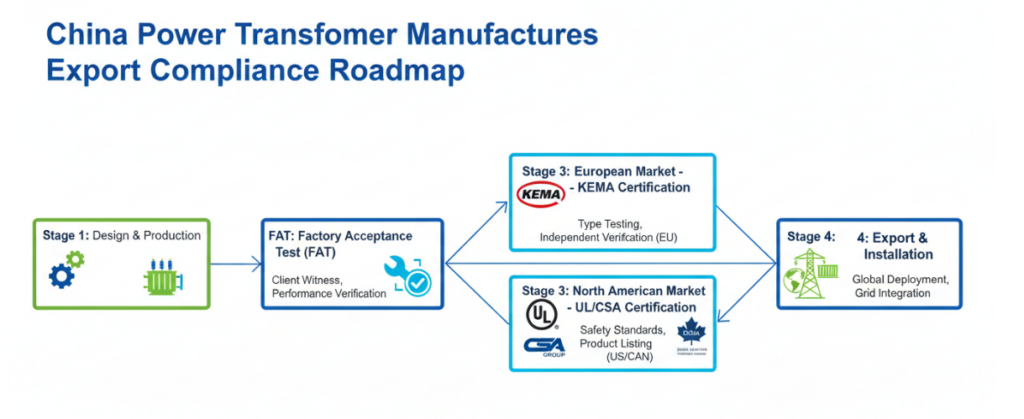
XD Group’s technical precipitation in the field of ultra-high voltage (UHV) makes it a must for multi-national grid procurement. EPC’s core reason for choosing Western Power is usually its excellent short-circuit withstand test (Short-Circuit Withstand Capability) data, which has been repeatedly certified by third-party authoritative laboratories in Europe and the United States (such as KEMA).
Baoding Tianwei Baobian (transformer protection electrical)
Baobian Electric occupies a unique niche in the field of large nuclear power transformers and offshore wind transformers. For overseas general contractors who need to customize special conditions such as anti-corrosion design and seismic design, Baobian provides a very cost-effective customized joint research and development program.
B2B procurement core framework: V.E.T. supplier fixed-point model
Relying on the outdated “three-way price comparison, low bid” strategy is doomed to fail in 2026. Due to fluctuations in raw materials, today’s low prices are likely to be the root cause of tomorrow’s unfinished business. I recommend that all EPC procurement executives immediately enable the V.E.T. model screening power transformers manufacturers:
V-Velocity (Delivery Guarantee): Don’t look at the delivery date promised in the sales contract, check whether the manufacturer has signed a long-term agreement order with silicon steel suppliers (such as South Korea’s Pohang and China’s Baowu). There is no long-term commitment to the bottom of the delivery, it is all waste paper.
E-Engineering (Multinational Engineering Pair Relay): Verify that the manufacturer has the ability to localize direct output of 3D CAD models. If the manufacturer’s design drawings require your American or European engineers to spend weeks on unit conversion and interface re-checking, the hidden costs will increase dramatically.
T-Transparency (raw material penetration): manufacturers are required to carry out “transparent disassembly” in the BOM (bill of materials) quotation “. How do the parties share the cost when copper prices exceed a certain trigger threshold? Refuse to accept the vague “force majeure price increase clause”.
EPC Practical Pit-Avoidance Guide: Beware of the “Paper Capacity” Trap
Experts engaged in international heavy electrical equipment procurement have experienced blood lessons. Here are two deadly potholes that could directly save millions of dollars in project profits.
Trap 1: using “nameplate capacity” to cover up “spot market dependence”
A second-tier manufacturer may claim to have an annual production capacity of 50,000 MVA. The factory is large enough and there are enough workers. But when the buyer paid 30% in advance, the manufacturer was slow to schedule production. The truth is: they do not have long-term core raw material contracts, can only go to the spot market “try their luck” to purchase expensive magnet wire and insulation paper. Once the spot is upside down, they would rather delay delivery to pay a meager penalty than make it at a loss. Countermeasures: In the factory review (Factory Audit) stage, mandatory inspection of its raw material turnover warehouse and nearly half a year’s purchase and sale bills.
Trap 2: hidden water release in FAT (factory acceptance test) link
In order to save money, some buyers entrust local non-professional third-party organizations to carry out FAT. Some manufacturers cheat by adjusting the early start time of the cooling fan in the temperature rise test (Temperature Rise Test) to cover up the problem of excessive core loss. Countermeasures: For large transformers above 100MVA, international first-line inspection institutions with special electrical background (such as special teams of SGS and TÜV) must be employed, and it is stated in the contract that “the background noise of partial discharge test (Partial Discharge Test) must be lower than the specified decibels” and the whole process is recorded.
FAQ
Q1: Who is the largest power transformer manufacturer in the world in 2026?
Hitachi Energy maintains its position as the world’s largest manufacturer, leading Siemens Energy and GE Vernova in terms of capacity scale, ultra-high voltage technology above 800kV and global service network.
Q2: What is the current lead time for power transformer manufacturers in USA?
As of 2026, the average delivery period of large power transformers (greater than 60MVA) in the United States has been extended to 100 to 140 weeks. The situation of medium-sized distribution transformers is slightly better, but it still takes 50-80 weeks.
Q3: Are China power transformer manufacturers accepted in US and European grids?
Absolutely. As long as the Chinese manufacturer has passed UL/CSA certification (for North America) or CE/KEMA certification (for Europe), and strictly complies with IEEE C57 or IEC 60076 standards. Head companies such as TBEA (TBEA) and China Western Power have had a large number of practical cases of successful grid-connected to Europe and the United States.
Q4: How can EPCs mitigate raw material price fluctuations when ordering transformers?
The Purchaser must introduce an index-based commodity price adjustment clause in the contract (Material the Price Escalation Clauses). Anchor the LME (London Metal Exchange) copper price and the designated silicon steel index to clarify the two-way sharing mechanism of the rise and fall risk.
Q5: What is the difference between Tier-1 and Tier-2 power transformers manufacturers?
Tier-1 manufacturers (such as Hitachi, Siemens) have the ability to set industry standards and global supply chains for very large grid hubs. Tier-2 manufacturers are regional, more price advantages and relatively agile delivery, is the best choice for medium-sized new energy grid-connected or industrial and commercial projects.
Discover The Key Difference Between Isolation Transformer And Step Down Or Up Models To Prevent Equipment Failures.
View detailsGuide For Power Transformer HS Code Classification And Safe Power Transformer Transportation Engineering.
View detailsDiscover How Power Transformers Work In 2026. Master Basic Principles, Core Parts, And Solid State Technology.
View detailsMaster Power Transformer Ratings With This 2026 Guide. Decode Symbols, Impedance, And Capacity To Avoid Failures.
View detailsPlease fill in the arithmetic result.
The calculation is incorrect, please fill it in again.