 BBELC
BBELC
DC Drive Isolation Transformer: Definition & Wiki Facts
31Master The DC Drive Isolation Transformer Definition And Wiki Facts To Prevent Costly Motor Failures.
View details
Search the whole station
Yes, 99% of large power transformers (LPTs, typically 100 MVA and above) are entirely custom-made. Expect to pay between $2.8 million and $4.5 million for a base 200 MVA unit in 2026. The final check your finance team signs will often run 15% to 25% higher than the initial quote. The culprits driving this price gap include severe shortages in Grain-Oriented Electrical Steel (GOES), mandatory site-specific dimensional engineering, and extreme heavy-haul logistics costs. Here is the raw data, exact cost breakdown, and engineering reality you need to budget accurately for Q3/Q4 2026 deliveries.
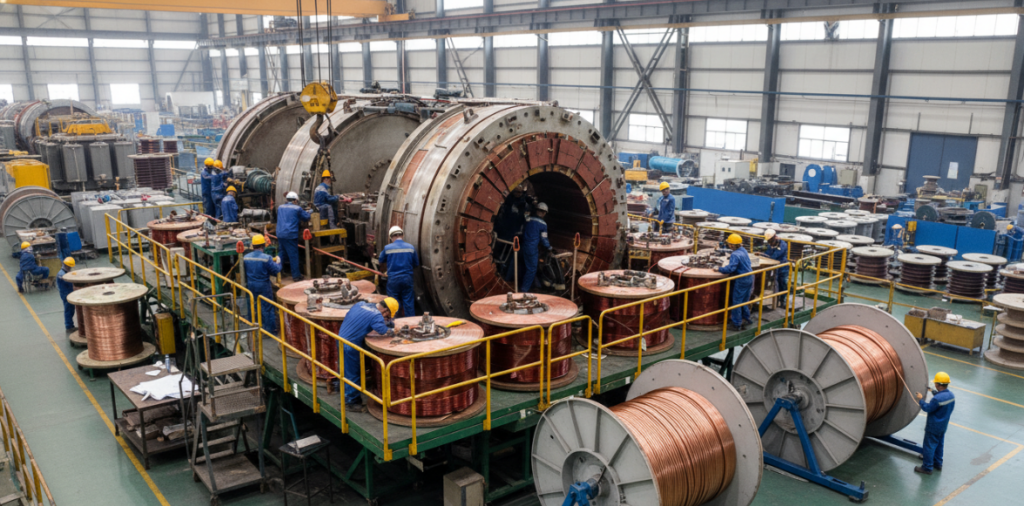
Large power transformers operate as the most critical nodes in high-voltage grid infrastructure, requiring exact synchronization with existing legacy systems. Utilities and private industrial grids dictate strict fault current limits, specific short-circuit impedance matching, and absolute dimensional limits for existing concrete pads. Off-the-shelf purchasing simply does not exist in the >100 MVA market.
Short-Circuit Impedance Matching. Substation upgrades require the new transformer to operate in parallel with existing units. Engineers must design bespoke core and coil assemblies to hit exact impedance percentages (e.g., 8.5% or 10%). Mismatched impedance causes unequal load sharing, forcing one unit to overheat and eventually fail.
Dimensional and Weight Constraints. Many urban and legacy industrial substations lack the physical real estate for larger modern units. Manufacturers must custom-engineer the internal active part and outer tank geometry to fit onto decades-old concrete foundations. Strict rail and bridge weight limits along the specific delivery route dictate the maximum permissible transport weight of the tank.
Custom Cooling Configurations (ONAF/OFAF/ODWF). Ambient climate data dictates the cooling methodology. A transformer destined for a solar farm in the Arizona desert requires vastly different radiator banking, pump specifications, and load tap changer (LTC) cooling capacities compared to a unit installed in an offshore wind integration site in the North Sea.
Procurement directors budgeting for 2026 must abandon historical pricing models from the 2010s. A standard 100 MVA unit starts around $1.5 million, while a high-voltage 500 MVA generation step-up unit easily exceeds $6 million. Base prices rely heavily on volatile commodity indexes, specifically copper and electrical steel.
To strip away supplier pricing ambiguity, project financial directors must use the T.C.O. Pricing Pyramid model.
Below is a hard-data projection for LPT pricing in 2026, assuming standard heavy-haul freight variables within the continental United States.
| Column 1: Capacity (MVA) | Column 2: Estimated Ex-Works Base Price (USD) | Column 3: Primary Voltage (kV) | Column 4: Current Lead Time Forecast |
| 10 – 30 MVA (Small Power Transformer) | $450,000 – $800,000 | 69 kV / 115 kV | 50 – 70 Weeks |
| 30 – 100 MVA (Medium Power Transformer) | $800,000 – $1,800,000 | 115 kV / 138 kV | 80 – 100 Weeks |
| 100 – 300 MVA (Large Power Transformer) | $1,800,000 – $3,500,000 | 138 kV / 230 kV | 100 – 130 Weeks |
| 300 MVA (Extra Large / Auto-Transformers) | $3,500,000 – $6,000,000+ | 345 kV / 500 kV | 120 – 150+ Weeks |
Market scarcity in 2026 leaves zero margin for procurement errors. Rushing a purchase order without auditing the tertiary costs routinely blows project budgets out of proportion.
Buyers routinely sign Ex-Works (EXW) or Free Carrier (FCA) contracts, ignoring the reality of moving a 400,000-pound piece of metal across state lines. Specialized Schnabel rail cars are required for transport. There are fewer than 40 of these specific rail cars operating in North America. Booking them requires 8 to 12 months of advance notice. Missing your rail window results in factory storage fees exceeding $50,000 per month and project delays that trigger massive liquidated damages.
Electrical engineers often copy-paste legacy specifications from 1990s transformers into new 2026 RFQs. Demanding an outdated, ultra-low impedance forces the manufacturer to use a significantly larger GOES core. This inflates the copper and steel bill of materials by up to 15%. Procurement teams must challenge their internal engineering departments to widen the acceptable impedance variance to allow for modern, cost-optimized core designs.
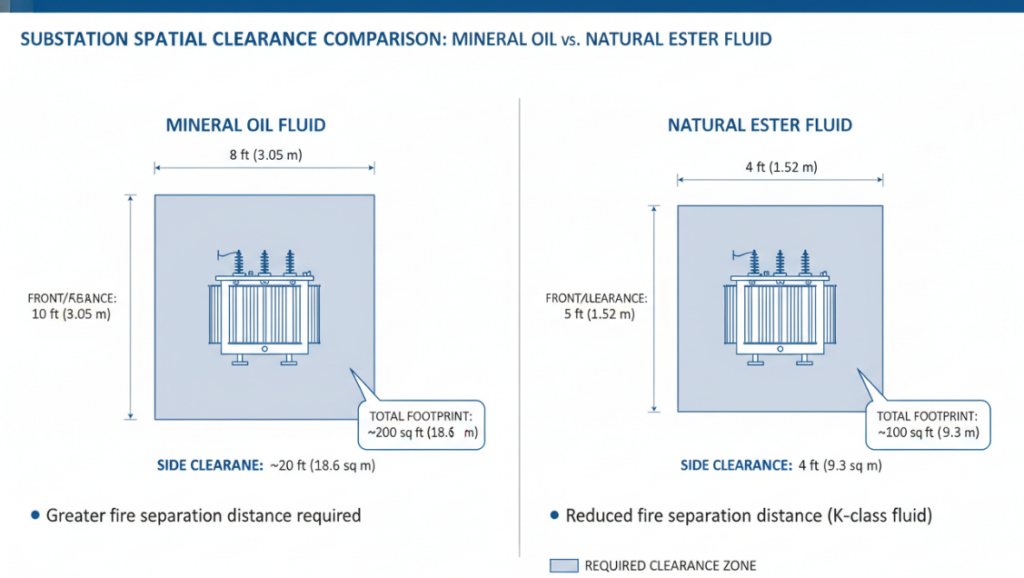
A major North American utility grid faced a $1.2 million civil engineering bill to expand a legacy substation footprint to accommodate a new, physically larger 250 MVA transformer.
Our engineering team intervened by shifting the specification from highly flammable standard mineral oil to a high-fire-point natural ester fluid. The superior fire-safety rating of the ester fluid allowed the utility to legally bypass the strict spatial clearance regulations (NFPA 850) that required massive firewalls and wider physical separation between units.
The natural ester fluid increased the base cost of the transformer by $140,000. However, eliminating the concrete expansion and firewall construction saved the project $1.2 million. The net financial result was a 12% reduction in total project capital expenditure, completed 4 months ahead of schedule.
Why is the lead time for large power transformers so long?
Global manufacturing capacity is constrained by a massive shortage of Grain-Oriented Electrical Steel (GOES) and a limited pool of specialized high-voltage winding engineers. Current lead times for units over 100 MVA range from 110 to 150 weeks.
Can you buy a used or refurbished large power transformer?
Yes, but availability is extremely low. Refurbished units are occasionally sourced for emergency replacements, but they rarely match the exact short-circuit impedance and footprint required by the permanent substation design.
What is the lifespan of a custom large power transformer?
A well-maintained LPT operates efficiently for 30 to 40 years. Continuous Dissolved Gas Analysis (DGA) monitoring and routine oil filtration significantly extend the internal insulation life.
How does copper pricing affect the cost of a power transformer?
Copper accounts for roughly 20% of the total manufacturing cost. A 10% spike in the London Metal Exchange (LME) copper index directly translates to a 2% increase in the final Ex-Works price of the transformer.
What is a Factory Acceptance Test (FAT) for a transformer?
A FAT is the final validation protocol where the buyer’s engineers travel to the manufacturing plant. The unit undergoes extreme high-voltage dielectric testing, heat run tests, and impulse tests to prove it meets the exact custom specifications before shipping.
Do large power transformers ship with oil inside?
No. Large power transformers ship filled with dry nitrogen gas to drastically reduce the transport weight. The insulating oil is shipped separately in tanker trucks and processed into the transformer on-site under vacuum.
Master The DC Drive Isolation Transformer Definition And Wiki Facts To Prevent Costly Motor Failures.
View detailsLarge Power Transformer Efficiency Losses Percentage Data: Audit Grid Harmonics And Optimize Asset Opex.
View detailsLearn What Causes Power Loss In A Transformer. Explore Key Factors, Core Loss, And Expert Troubleshooting Skills.
View detailsStop Power Transformer Failure: Decode Bad Symptoms And Humming Sounds. Find Hidden Causes With Our H.E.A.T. Guide.
View detailsPlease fill in the arithmetic result.
The calculation is incorrect, please fill it in again.