 BBELC
BBELC
Power Transformer Type Test: How To Check Performance
8Power Transformer Type Test: Learn How To Check Performance, Audit Factory Data, And Avoid Hidden Defects.
View details
Search the whole station
A power transformer is a static electrical machine that transfers alternating current (AC) electricity between circuits to step voltage up or down. That is the exact way industry engineers define power transformer. You need these devices because power plants generate electricity at low voltages, but transmitting that power across long distances requires massive voltage pushes to prevent energy loss. If you are an engineering student or a grid technician trying to grasp how power transformers work, typical textbooks will bury you in calculus and Faraday’s equations. We skip the math here. This guide breaks down power transformer basics using a mechanical gearbox analogy, reveals the specific startup mistakes that destroy beginner circuits, and exposes how 2026 AI data center demands are forcing legacy transformer designs into retirement.
Power transformers manipulate electricity to make long-distance transmission possible. They trade voltage for current, or current for voltage, without changing the frequency of the power supply. A step-up transformer increases voltage for transmission lines. A step-down transformer decreases that voltage back to safe levels for factories and homes.
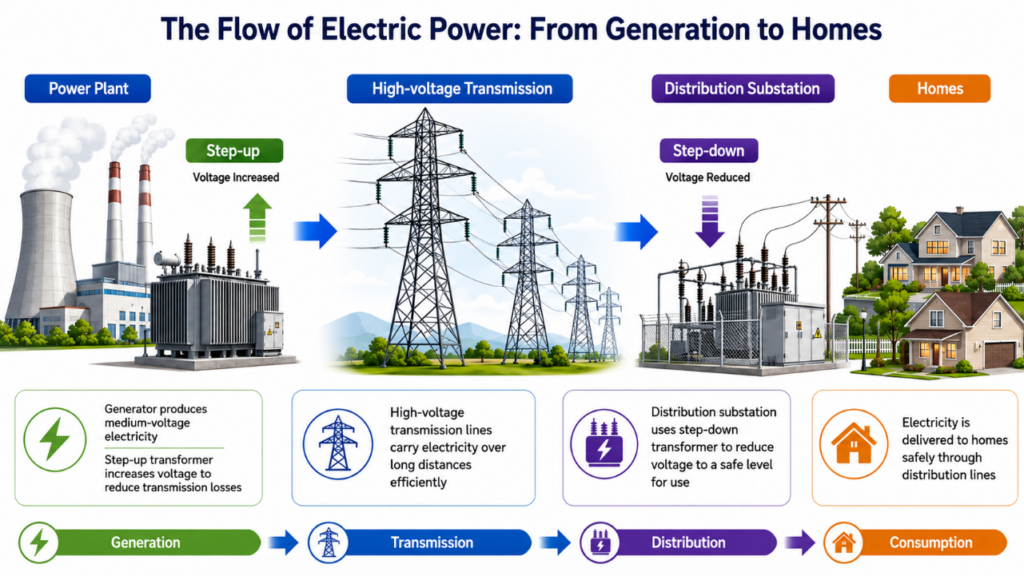
They operate entirely on the principle of electromagnetic induction. Two separate coils of wire wrap around a single metal core. The electrical circuits never physically touch. The energy travels between them entirely as a fluctuating magnetic field.
You can master the power transformer working principle instantly by looking at a manual car transmission. Transformers do for electricity exactly what a gearbox does for an engine.
In a car, you trade speed for torque. In an electrical grid, you trade voltage (speed) for current (torque).
The input side of the transformer is the primary winding. Think of it as the gear attached to the car’s engine. AC power flows into this coil, turning the electrical energy into a pulsing magnetic field. If this primary coil has fewer turns of wire than the output side, it acts like a small drive gear spinning against a larger gear.
The output side is the secondary winding. The magnetic field from the primary coil pushes through the metal core and forces electrons to move in this secondary coil. If the secondary coil has more wraps of wire, the voltage increases (steps up), but the current drops. You get higher electrical “speed” but lower electrical “torque.” Total power stays exactly the same, minus a tiny fraction of heat loss.
A transformer relies on three physical elements to force electromagnetic induction to happen efficiently. You cannot just place two wires next to each other and expect grid-level power transfer.
Engineers build transformer cores from stacks of thin silicon steel sheets. Solid blocks of steel fail in this application. The pulsing magnetic field creates stray “eddy currents” inside the metal, rapidly heating a solid block until the machine catches fire. By slicing the steel into thin, insulated layers (laminations), manufacturers trap the magnetic field while killing those dangerous heat-generating currents.
Transformers use massive coils of copper or aluminum wire. Since the wires sit packed tightly together, the insulation wrapped around them prevents short circuits. Industrial units use special Kraft paper wrapped around the copper. Over time, heat degrades this paper, which is the primary reason transformers eventually fail.
High-voltage transformers drown their internal parts in highly refined mineral oil. Air cannot cool a 50-megawatt substation transformer fast enough. The oil pulls heat away from the core and acts as a massive liquid insulator to prevent electrical arcs from jumping between the high-voltage coils.
University labs see dozens of blown fuses every semester because beginners ignore residual magnetism. When you shut off a transformer, a phantom magnetic field stays locked inside the steel core.
When you turn the power back on, the new electrical cycle might push the magnetic field in the exact same direction as the residual field. The steel core instantly hits “saturation”—it cannot hold any more magnetism. For a fraction of a second, the transformer acts like a dead short circuit. It pulls an explosive spike of power called Inrush Current, which can be 10 to 40 times higher than the normal operating current. Experienced technicians always use protective relays and soft-start mechanisms to catch this spike before it melts the breaker panel.
The explosion of AI data centers in 2026 pushed traditional oil-filled transformers to their physical limits. Data centers require massive, instantaneous power shifts. The industry is currently shifting toward Solid-State Transformers (SSTs) for hyper-scale infrastructure.
SSTs use high-frequency power electronics (like silicon carbide transistors) to step down voltage digitally. They are smaller, eliminate toxic cooling oils, and actively route power grid loads in real time.
| Feature | Traditional Transformer | Solid-State Transformer (SST) 2026 |
| Working Mechanism | Heavy copper coils and steel cores | High-frequency digital transistors |
| Size & Weight | Massive, requires heavy machinery | 50% lighter, highly modular |
| Grid Interaction | Passive (Only steps voltage up/down) | Active (Can reroute power smartly) |
| Cooling | Mineral oil (Fire hazard) | Advanced heat sinks (Dry type) |
Does a power transformer convert AC to DC?
No. Transformers only change voltage levels for alternating current (AC). Converting AC to direct current (DC) requires a separate device called a rectifier.
Why do power transformers hum?
The hum comes from a physical reaction called magnetostriction. The alternating magnetic field forces the steel sheets inside the core to stretch and contract 120 times per second (in a 60Hz system). This rapid vibration creates the buzzing sound.
Can a transformer work with direct current (DC)?
A transformer will instantly short circuit and burn up if connected directly to a high-voltage DC source. Electromagnetic induction only works when the magnetic field is constantly changing. DC creates a static, unmoving magnetic field, generating zero output voltage and massive heat.
What is the difference between a distribution and power transformer?
Engineers use power transformers at generation plants and transmission networks to handle extreme voltages (above 33kV) at 100% constant loads. Distribution transformers sit on utility poles in residential neighborhoods, stepping the voltage down to 120V/240V, and handle fluctuating loads based on consumer usage.
What causes a power transformer to explode?
Lightning strikes, severe grid overloads, or degraded internal paper insulation cause electrical arcs inside the tank. The arc vaporizes the cooling oil instantly, creating highly explosive gases. The pressure bursts the steel tank and ignites the gas.
Power Transformer Type Test: Learn How To Check Performance, Audit Factory Data, And Avoid Hidden Defects.
View detailsAre Large Power Transformers Custom Made? Get Exact 2026 Power Transformer Pricing, Hidden Costs, And Hard Market Data.
View detailsPower Transformers Manufacturers: Top 2026 Global List. Find Largest USA And China Suppliers To Avoid Lead Time Traps.
View detailsStop 2026 Utility Fines From No-Load Transformer Power Factor. Prevent Off-Peak Energy Loss With Our MAP Framework.
View detailsPlease fill in the arithmetic result.
The calculation is incorrect, please fill it in again.