 BBELC
BBELC
Grounding Isolation Transformer: 5 Proven Practices
11Master Grounding Isolation Transformer Setups With 5 Proven Practices. Stop Ground Loops Using The P.A.C.T. Method.
View detailsSearch the whole station
An isolation transformer physically separates the primary power source from the secondary load to block hazardous electrical noise and prevent electric shock. A step-up or step-down transformer simply alters the voltage level from input to output. Confusing voltage conversion with true galvanic isolation is a fatal engineering error. Using a standard step-down voltage converter when your sensitive industrial equipment actually requires pure isolation will fail to stop common-mode noise, risking immediate destruction of expensive programmable logic controllers during a ground fault.
We recently inspected an industrial facility where a procurement error led to precisely this scenario. Read the exact test data below to see how standard voltage converters fail our safety grounding tests, and learn how to specify the correct hardware.
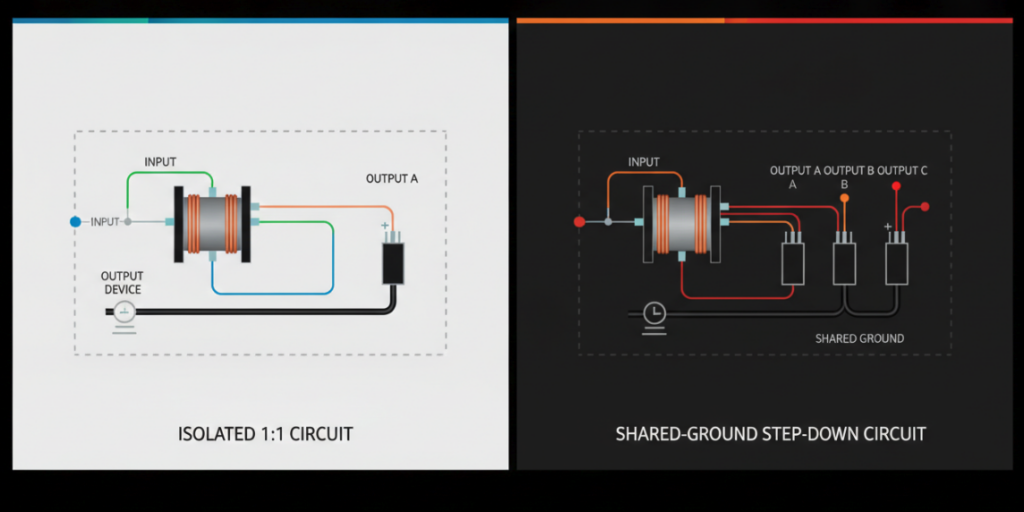
Engineers waste hours debating transformer specs. The “V-I-G Protocol” cuts through the noise and dictates exactly which unit fits your application.
You must evaluate all three variables. Equipment manufacturers often mandate specific isolation requirements that standard step-up or step-down units ignore completely.
A step-down transformer reduces high input voltage to a lower output voltage but lacks the internal shielding required to block electrical interference. The exact difference between isolation transformer and step down transformer lies in the winding construction and the handling of line noise. Standard step-down units transfer power through magnetic induction but still allow common-mode noise to pass directly from the utility grid to your sensitive electronics.
An isolation transformer utilizes a Faraday shield between the primary and secondary coils. This shield intercepts high-frequency noise and shunts it safely to ground.
The Autotransformer Trap in Voltage Reduction
Many budget-friendly step-down units are actually autotransformers. They use a single continuous wire winding with a tap point to reduce voltage. They share a common electrical ground between the input and output. An isolation transformer uses two distinct, physically separated coils. If a power surge hits an autotransformer, the shared ground delivers that surge straight into your connected load.
| Feature | Step-Down Autotransformer | Isolation Transformer |
| Noise Attenuation Level | Low to Moderate (Direct electrical connection between primary and secondary) | High (Galvanic isolation between primary and secondary windings) |
| Winding Type | Single winding with taps (part of the same winding is common to both primary and secondary) | Two or more separate windings (primary and secondary are electrically isolated) |
| Ground Fault Safety | Limited improvement in safety (common neutral/ground reference) | Enhanced safety (creates a new isolated neutral/ground reference, preventing fault currents from returning to the source) |
A step-up transformer increases voltage to compensate for line drop over long distances, but it does nothing to separate the circuit’s grounding paths. The critical difference between isolation transformer and step up transformer involves the prevention of ground loops. Ground loops occur when two connected devices have different ground potentials, causing destructive stray currents to flow across the data or power cables.
An isolation transformer breaks the physical connection, eliminating the path for these ground loops. A standard step-up transformer maintains the continuity of the neutral and ground wires.
Handling Ground Loops in High-Voltage Systems
Solar inverters and EV charging stations require stepping up low-voltage DC-converted AC to grid levels. If an engineer uses a non-isolated step-up unit here, stray currents will trigger ground fault circuit interrupters and cause persistent system shutdowns. True isolation transformers establish a clean ground reference, preventing these nuisance trips.
Industrial facilities frequently need both voltage conversion and electrical isolation. The difference between step-up step-down and isolating transformer categories often blurs because manufacturers combine these functions into a single unit known as an “isolating step-down transformer.”
A standalone step-up or step-down unit alters the voltage amplitude. A standalone isolation unit cleans the power and separates the circuits. When combined, the transformer features separate primary and secondary windings with different numbers of turns on each coil.
Always check the nameplate. If it specifies “Autotransformer,” it only performs step-up/step-down functions and lacks galvanic isolation. If it specifies “Isolation Winding” or “Separately Derived System,” it handles both safety and voltage alteration.
Last year, an automotive parts manufacturer installed three new 5-axis CNC machines. The machines required 208V, but the facility grid supplied 480V. The purchasing department bought standard 480V-to-208V step-down autotransformers to save $2,000 per unit.
Because standard step-down units do not isolate the circuits, high-frequency switching noise from a nearby robotic welding arm traveled back into the shared power line. The noise passed straight through the step-down transformers, corrupting the CNC logic controllers. Two weeks after installation, one PLC suffered total logic board failure—a $50,000 replacement. Replacing the cheap step-down units with true step-down isolation transformers provided the necessary Faraday shielding, instantly eliminating the interference.
What is the main difference between step down transformer and isolation transformer?
A step-down transformer specifically lowers the voltage level without necessarily separating the input and output circuits. An isolation transformer physically separates the circuits using separate windings to block electrical noise and prevent shocks, typically maintaining the same voltage level.
Can an isolation transformer be used as a step down transformer?
Yes. Manufacturers build “step-down isolation transformers.” These hybrid units have separate primary and secondary windings to ensure galvanic isolation, while the secondary winding has fewer turns than the primary to lower the voltage.
Why use an isolation transformer instead of a step up transformer?
You specify an isolation transformer when you need to eliminate ground loops, block common-mode electrical noise, or establish a separate neutral-ground bond. A standard step-up transformer only increases voltage and offers zero protection against these power quality issues.
Does a step down transformer provide galvanic isolation?
Only if it is explicitly built with separate primary and secondary windings. If the unit is an autotransformer, it shares a common ground and provides zero galvanic isolation.
How do I test the difference between step-up step-down and isolating transformer units?
Use a digital multimeter to measure continuity between the primary and secondary windings. An isolating transformer will show infinite resistance between the primary and secondary coils. A standard step-up or step-down autotransformer will show continuity, proving the circuits are physically connected.
Master Grounding Isolation Transformer Setups With 5 Proven Practices. Stop Ground Loops Using The P.A.C.T. Method.
View detailsMaster Distribution Transformer Winding Connections. Discover Core Rules, Vector Groups, And The Zero-Fault Framework.
View detailsDistribution Vs Power Transformer: 5 Core Differences. Master The L.E.N.S. Framework To Avoid Costly Sizing Traps.
View details2026 Guide For 33 6.6 KV Step Up And Step Down Power Transformer. Master VIP Selection Matrix And FAT Specs.
View detailsPlease fill in the arithmetic result.
The calculation is incorrect, please fill it in again.