 BBELC
BBELC
Core Field Tests: Power Transformer Insulation Resistance
18Master Field Tests For Power Transformers. Execute Insulation Resistance Test Of Power Transformer Assets Accurately.
View details
Search the whole station
An isolation transformer is a magnetic device designed to transfer alternating current (AC) power from a source to an electrical device while physically separating the two circuits. The definition of isolation transformers centers on their 1:1 winding ratio: they do not step voltage up or down, but rather recreate the AC voltage on the secondary side using only a magnetic field.
Most novice engineers and equipment buyers assume standard circuit breakers or basic power strips offer complete equipment protection. That assumption costs industrial facilities and server rooms thousands of dollars in fried circuit boards every year. Standard protective devices rely on a shared ground connection, leaving a direct physical path for electrical noise and lethal fault currents to travel. To truly safeguard sensitive medical equipment, lab testing gear, or heavy industrial machinery, you must physically sever the electrical tie to the main power grid. Below is the exact mechanical breakdown of how isolation transformers achieve this, along with the five critical functions you need to know before making your next equipment purchase.
Understanding how an isolation transformer works requires looking beyond copper wires. I use the “G.N.P. Triangle” model to train junior electrical engineering interns on the core mechanics.
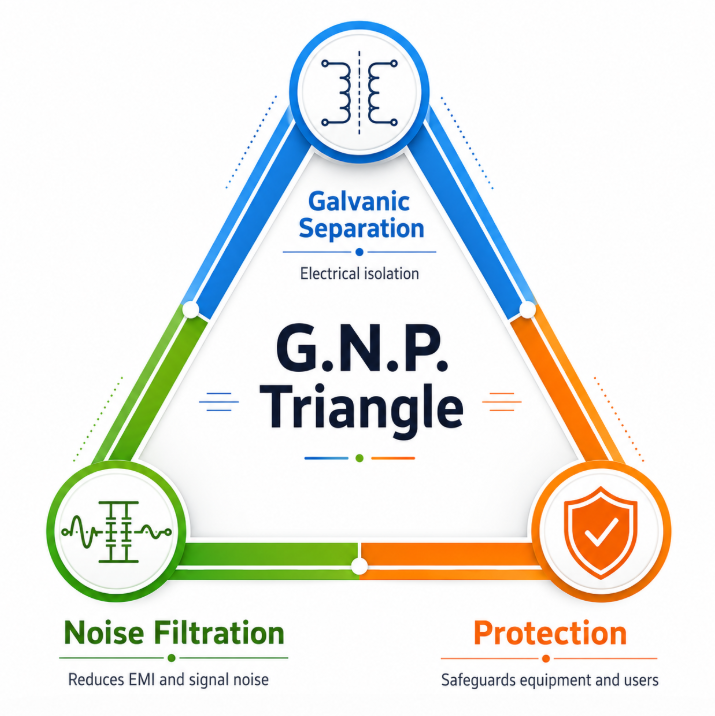
Galvanic Separation (The Magnetic Bridge). The input power (primary winding) and the output power (secondary winding) never touch. The primary coil turns the incoming AC power into a fluctuating magnetic field. The secondary coil intercepts this magnetic field and converts it back into electrical current. The power jumps across an invisible gap.
Noise Filtration (The Clean Slate). The power grid carries high-frequency noise from thousands of other connected devices. The magnetic gap inside the transformer acts as a toll booth. Low-frequency AC power (50Hz/60Hz) passes through easily, while high-frequency electrical noise fails to cross the magnetic barrier effectively, delivering “clean” power to the output side.
Protection (The Floating Ground). A standard wall outlet is referenced to the earth ground. If you touch a live wire and the floor, your body completes the circuit. The output of an isolation transformer creates a “floating” power source. Because the secondary circuit lacks a direct connection to the earth ground, touching a single live wire on the output side will not result in a shock. The electrical current has no path back to its source through you.
Every function of an isolation transformer stems from its ability to separate the primary source from the secondary load.
Galvanic isolation physically blocks direct current (DC) and stray AC currents from passing between two sections of a system. The primary and secondary copper windings are wrapped around a common magnetic core, separated by thick dielectric insulation. This function guarantees that a catastrophic failure on the power grid side (like a massive voltage spike) hits a dead end at the transformer, rather than melting the internal components of your connected CNC machine or IT server.
Ground loops occur when two connected pieces of equipment have slightly different ground voltage potentials, causing an unintended current to flow between them via data cables. The isolation transformer breaks the ground loop by providing a new, isolated local ground reference for the connected device. Audio engineers rely heavily on this function to eliminate the distinct 60Hz hum in speaker systems caused by ground loop currents.
High-quality isolation transformers utilize a grounded Faraday shield placed between the primary and secondary windings. Capacitive coupling naturally occurs between the two coils, allowing common-mode electrical noise to sneak across. The Faraday shield intercepts this capacitive noise and dumps it directly to the ground before it can reach the secondary winding. This function provides the hyper-clean power required by sensitive ECG machines in hospitals and precision measurement tools in laboratories.
Equipment testing and repair expose technicians to bare wires and live circuits. The function of an isolation transformer here is to remove the earth-ground reference. An oscilloscope plugged into a standard outlet is grounded to the earth. If a technician probes a live circuit, they risk creating a short circuit through the test equipment. Plugging the device under test into an isolated transformer ensures the circuit is “floating.” The current will not use the technician’s body as a shortcut to the earth, drastically reducing the risk of electrocution.
Modern power grids are polluted by harmonic distortion created by thousands of LED lights, EV chargers, and switching power supplies. The magnetic core of an isolation transformer naturally resists passing these high-frequency harmonics. This containment function prevents internal micro-faults—such as localized overheating in an EV charging station controller—from feeding noise back into the main building power grid, keeping other facility electronics stable.
Procurement teams frequently waste budget on incorrect transformer types. My past field tests and purchasing audits reveal three consistent errors you must sidestep.
| Comparison Dimension | Isolation Transformer | Auto-Transformer | Standard UPS |
|---|---|---|---|
| Physical Separation | Full electrical isolation; primary and secondary windings are physically separated | No full isolation; input and output share part of the winding | Usually no full isolation unless an isolation transformer is built in |
| Cost | Higher cost due to larger size, more copper/iron, and heavier construction | Lower cost due to simpler design and reduced material use | Medium to high cost depending on power rating, topology, and battery configuration |
| Common-Mode Noise Rejection | Strong; effectively reduces common-mode noise and ground-related interference | Weak; limited noise rejection because there is no galvanic isolation | Moderate; online UPS systems perform better than standby or line-interactive UPS systems |
Mistake 1: Buying an Auto-transformer Instead of a True Isolation Transformer.
Auto-transformers use a single continuous coil for both input and output. They can step voltage up or down and cost significantly less than isolation transformers. They offer zero galvanic isolation. If a power surge hits an auto-transformer, it travels directly into your equipment. Always verify the spec sheet specifically states “galvanic isolation” or “double-wound primary/secondary.”
Mistake 2: Ignoring Inrush Current Derating.
Heavy machinery with large motors draws up to ten times its normal operating current during the first few milliseconds of startup. Buyers often match the transformer’s VA (Volt-Ampere) rating exactly to the machine’s running wattage. The transformer core will saturate during the initial motor startup, dropping the voltage and causing the machine to stall or the transformer to overheat. Always size the isolation transformer at least 20-30% above the peak inrush current requirement.
Mistake 3: Overlooking Medical-Grade Certifications (IEC 60601-1).
Standard industrial isolation transformers leak a tiny amount of current (leakage current) due to stray capacitance. While safe for industrial tools, this leakage is lethal in medical settings where equipment directly touches patients. If purchasing for healthcare facilities, the transformer must carry the IEC 60601-1 certification, which dictates maximum leakage currents well below standard commercial limits.
Can an isolation transformer step down voltage?
Yes. While the standard definition of an isolation transformer implies a 1:1 ratio, manufacturers often wind the secondary coil with fewer turns to provide both galvanic isolation and voltage step-down (e.g., converting 240V to 120V) in a single unit.
Does an isolation transformer protect against lightning strikes?
No. A massive lightning strike can produce voltage so high that it arcs physically across the air gap between the primary and secondary windings. You still need dedicated surge protection devices (SPDs) installed upstream of the transformer.
Why is my isolation transformer buzzing?
The buzzing sound comes from magnetostriction—the microscopic expansion and contraction of the steel core laminations as the alternating magnetic field passes through them. A loose core or overloading the transformer will make this sound noticeably louder.
Do isolation transformers consume power when idle?
Yes. Even with nothing plugged into the secondary side, the primary coil still draws a small amount of current to maintain the magnetic field. This is known as “no-load loss” or core loss.
Can I use a UPS instead of an isolation transformer?
A standard line-interactive UPS does not provide true galvanic isolation. Only specific “double-conversion online UPS” systems with built-in isolation transformers offer both battery backup and total physical separation from the grid.
How do you test if an isolation transformer is working?
Disconnect all power. Use a digital multimeter set to the continuity or resistance (Ohms) function. Measure the resistance between any wire on the primary plug and any wire on the secondary outlet. The multimeter should read “OL” (Open Loop) or infinite resistance, confirming complete physical separation. this risk over just a few dozen yuan’s worth of stuff. After changing the new watch, remember to operate the air relief valve exhaust by the way, safety first.
Master Field Tests For Power Transformers. Execute Insulation Resistance Test Of Power Transformer Assets Accurately.
View detailsHow Do Power Transformers Work? Master Output Rating Metrics And The Isolation Transformer Symbol For Smart Sizing.
View detailsDiscover Low Voltage Isolation Transformers: Avoid Phantom Grounding Traps And Use The CLIP Matrix For Clean Power.
View detailsCompare Distribution Vs Power Transformer Specs. Find The Key Difference, Avoid Oversizing And Optimize Costs.
View detailsPlease fill in the arithmetic result.
The calculation is incorrect, please fill it in again.