 BBELC
BBELC
No Load Transformer Power Factor: Stop 2026 Energy Loss
28Stop 2026 Utility Fines From No-Load Transformer Power Factor. Prevent Off-Peak Energy Loss With Our MAP Framework.
View detailsSearch the whole station
As long as a transformer remains connected to the primary power grid, it continuously consumes electrical energy, even if the secondary side is completely disconnected and no equipment is running. This phenomenon, known in electrical engineering as no-load loss or core loss, provides an absolute answer to the core question: does a transformer always draw power? Yes. The primary coil’s excitation current must continuously generate the alternating magnetic field, resulting in constant power draw.
So, how much power does a transformer consume when idle? Under standard test conditions, a distribution transformer’s standby power consumption typically ranges from 0.5% to 2% of its total kVA rating. A 1000 kVA transformer, sitting completely idle, will drain approximately 13,000 to 17,000 kWh annually.
Relying solely on factory nameplate data to calculate your operational costs, however, is a critical engineering mistake. Actual grid voltage harmonics and slight overvoltage conditions frequently push the iron core into magnetic saturation, making real-world idle consumption 15% to 30% higher than stated on paper. We will dismantle the physics behind transformer no-load loss and expose why this 24/7 “invisible power drain” is a major compliance blind spot in current Scope 2 ESG carbon accounting.
The absolute magnitude of a transformer’s idle power consumption directly correlates with its physical mass and rated capacity (kVA). Larger transformers require higher absolute excitation currents to maintain their magnetic fields, even though their no-load loss might represent a lower percentage of total capacity.
Modern distribution transformers strictly limit no-load losses to meet DOE 2016 or European EcoDesign Tier 2 efficiency standards. For medium dry-type transformers, idle consumption hovers between 1% and 2% of the total nameplate rating. For large liquid-filled transformers, engineers control this ratio to approximately 0.5%.
Typical Transformer Idle Power Consumption by kVA Rating
| kVA Rating | Transformer Type (DOE 2016 Compliant) | Typical No-Load Loss (Watts) | Estimated Annual Idle Consumption (kWh) |
| 50 kVA | Liquid-Immersed, 3-Phase | 130 W | 1,139 kWh |
| 500 kVA | Liquid-Immersed, 3-Phase | 720 W | 6,307 kWh |
| 1500 kVA | Liquid-Immersed, 3-Phase | 1,750 W | 15,330 kWh |
| 2500 kVA | Liquid-Immersed, 3-Phase | 2,550 W | 22,338 kWh |
The molecular structure of the core material establishes the hard floor for standby power consumption. Traditional Cold Rolled Grain Oriented silicon steel exhibits average no-load performance, whereas Amorphous Metal Distribution Transformers utilize a disordered atomic structure that drastically reduces magnetization resistance.
In a real-world pure idle test of a 2500kVA data center transformer over a 48-hour weekend:
Electromagnetic conversion never stops once primary voltage is applied. The physical infrastructure required to maintain electromagnetic induction demands continuous energy.
Transformers convert 99% of no-load loss directly into heat dissipation. This heat generation consists of two distinct physical phenomena operating simultaneously within the core:
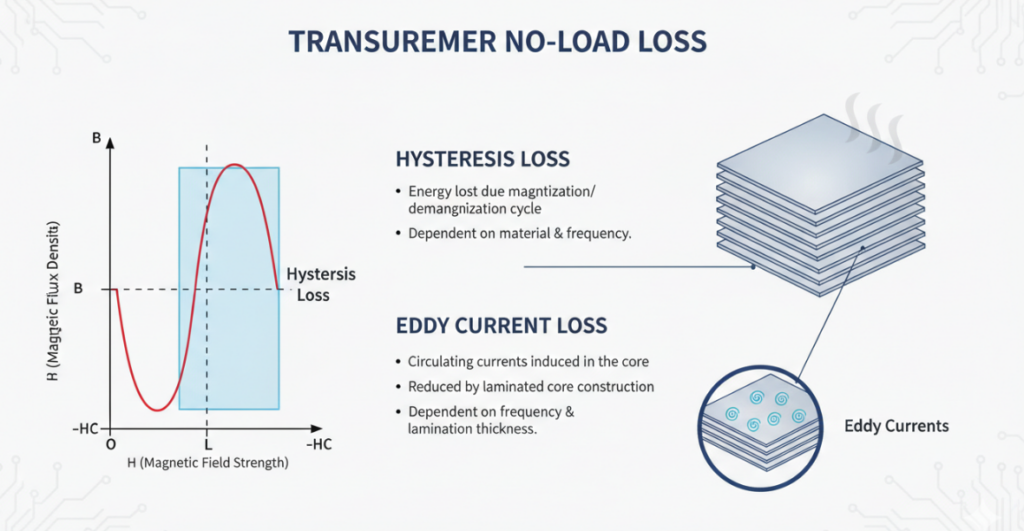
Energy auditors consistently lack a standardized protocol for evaluating transformer standby consumption. We developed the proprietary I.D.L.E. Framework specifically to address this gap:
Assuming actual field consumption equals the manufacturer’s specification is the most frequent error made by engineering teams. Site-specific power quality dictates the true absolute value of core loss, and two specific factors routinely destroy theoretical calculations.
Modern industrial facilities inject high-frequency harmonics into the grid through Variable Frequency Drives, LED lighting, and switched-mode power supplies. Because eddy current loss is proportional to the square of the frequency, voltage harmonics multiply core losses exponentially. Systems with severe 5th, 7th, or 11th order harmonics experience standby core losses 20% higher than pure sine wave environments, even at zero load.
Transformers exhibit extreme sensitivity to overvoltage conditions. Plant engineers frequently set primary tap changers high to compensate for line voltage drops, forcing the transformer to operate continuously at 105% or 107% of its rated voltage. Modern core designs place the nominal operating point very close to the knee point of the B-H curve. A mere 5% overvoltage pushes the core into magnetic saturation. Once saturated, excitation current spikes exponentially, causing idle power consumption to surge far beyond nameplate ratings.
Environmental, Social, and Governance compliance mandates extreme accuracy. Underreporting 24/7 continuous base loads exposes organizations to severe audit risks. Transformer no-load loss operates constantly throughout the year, classifying directly as a Scope 2 emission source.
A manufacturing plant with ten 2000kVA silicon steel transformers failing to account for harmonic-induced extra idle power will underreport its consumption by over 40,000 kWh annually. Applying the I.D.L.E. framework to accurately audit true standby power draw is a strict compliance baseline for corporate carbon asset management, far beyond a simple electrical engineering task.
1. Can a transformer be left plugged in with no load?
Yes. In industrial settings, facility managers leave distribution transformers energized 24/7. Frequently switching high-voltage primary power causes massive inrush currents, placing severe mechanical stress on the insulation system and shortening equipment lifespan. Engineers only recommend primary disconnection during extended plant shutdowns spanning several weeks.
2. What is the difference between no-load loss and load loss in transformers?
No-load loss occurs in the iron core and remains constant as long as the transformer is energized, regardless of the connected load. Load loss occurs in the copper or aluminum windings due to conductor resistance and increases exponentially as the connected equipment draws more current.
3. Does an unloaded transformer affect the power factor?
Yes. An idle transformer acts as a highly inductive load, absorbing reactive power from the grid to sustain its magnetic field. This drastically lowers the power factor at that specific electrical node. Facilities with multiple unloaded transformers often require capacitor banks to provide reactive compensation and avoid utility penalties.
4. Do small electronic transformers consume power when idle?
Absolutely. Small switched-mode power supplies or traditional linear adapters consume standby power as long as they remain plugged into the receptacle. Often referred to as vampire power or phantom load, these individual units drain 0.1W to 0.5W, creating a massive cumulative energy draw at scale.
5. How do you accurately measure transformer idle consumption in the field?
Standard clamp meters fail in this scenario. The power factor under no-load conditions is extremely low, creating a huge discrepancy between apparent power and active power. Auditors must use a high-precision power quality analyzer capable of measuring high-frequency harmonics to read the True RMS active power directly at the primary side.
6. Are amorphous metal transformers better for reducing idle consumption?
Yes. The core material in amorphous metal transformers lacks a crystalline structure, making it incredibly easy to magnetize and demagnetize. They reduce standby power consumption by 60% to 70% compared to traditional grain-oriented silicon steel, serving as a highly effective hardware upgrade for cutting long-term idle costs.
Stop 2026 Utility Fines From No-Load Transformer Power Factor. Prevent Off-Peak Energy Loss With Our MAP Framework.
View detailsAre Large Power Transformers Custom Made? Get Exact 2026 Power Transformer Pricing, Hidden Costs, And Hard Market Data.
View detailsDiscover How Isolation Transformers Work. Learn The Definition, 5 Critical Functions, And Buyer Pitfalls.
View detailsStop Power Transformer Failure: Decode Bad Symptoms And Humming Sounds. Find Hidden Causes With Our H.E.A.T. Guide.
View detailsPlease fill in the arithmetic result.
The calculation is incorrect, please fill it in again.