 BBELC
BBELC
GFCI Vs Isolation Transformer: Vital Safety Differences
33GFCI Vs Isolation Transformer: Vital Safety Differences, Expert Insights, And Pro Tips To Prevent Shocks Effectively.
View details
Search the whole station
Effective power transformer maintenance and testing in 2026 demands a strict transition from arbitrary calendar-based schedules to dynamic, condition-based interventions driven by edge-computing algorithms. Asset managers extending transformer life beyond 40 years currently prioritize real-time dissolved gas analysis (DGA), continuous bushing monitoring, and targeted sweep frequency response analysis (SFRA). Relying on legacy time-based testing wastes capital maintenance budgets and allows rapid, localized degradation events to cause catastrophic failures. We will detail the exact protocols top-tier energy facilities use to predict faults months before relay trips occur.
Resource allocation dictates asset longevity. Energy asset managers utilize the 3-Tier Transformer Resilience Pyramid to categorize and execute interventions effectively. Tier 1 establishes the baseline with continuous online condition monitoring of power transformers, capturing anomalies in real-time. Tier 2 implements targeted preventive maintenance of power transformer components based on Tier 1 data. Tier 3 reserves invasive, offline testing for validating structural integrity after severe grid faults.
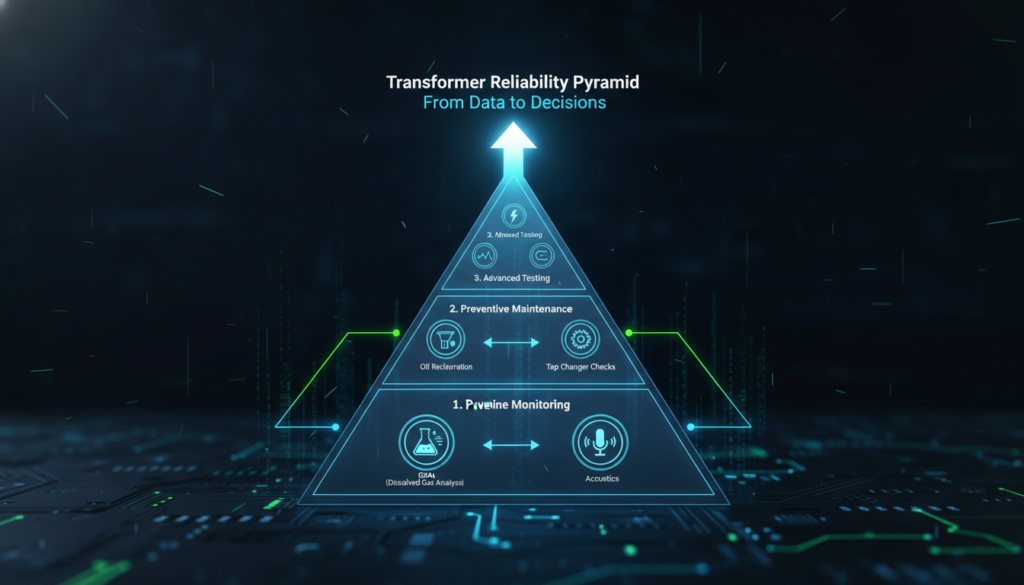
Continuous data acquisition prevents localized thermal and electrical stresses from developing into runaway cascade failures. Online condition monitoring of power transformers acts as the central nervous system for modern substations. Engineers no longer wait for annual fluid samples to detect arcing or partial discharge.
Processing diagnostic data locally at the transformer cabinet eliminates the latency and cybersecurity risks associated with cloud-based analytics. Modern multi-gas online DGA sensors integrate directly with acoustic emission monitors using Edge AI microprocessors. The system correlates a sudden spike in hydrogen (
H2H2) with high-frequency acoustic pings to instantly confirm active internal arcing. Grid operators receive actionable fault categorizations rather than raw data logs.
| Parameter | Legacy DGA Sampling | 2026 Edge AI Online Monitoring |
| Data Latency | Weeks to Months (manual collection) | Real-time (milliseconds) |
| Fault Resolution | General (requires lab analysis) | Specific (AI-driven pattern recognition) |
| Cybersecurity Risk | Low (physical sample, human interaction) | Moderate to High (networked devices, data transmission) |
| Cost per Annum | Moderate (labor, lab fees, consumables) | High initial investment, lower operational (predictive maintenance savings) |
Bushing failures cause nearly 30% of all catastrophic transformer explosions. High-voltage condenser bushings require continuous monitoring of capacitance (
C1C1/
C2C2) and Power Factor/Tan Delta. When moisture ingresses or paper layers puncture, the capacitance value shifts instantly. Setting an automated alarm for a capacitance change exceeding 1.5% from the nameplate guarantees operators can de-energize the unit before a catastrophic physical rupture.
Halting the physical degradation of cellulose insulation requires proactive chemical management. Preventive maintenance of power transformer fleets centers on managing the dielectric and chemical stability of the insulating fluid. The solid paper insulation determines the absolute end-of-life of the transformer; the oil simply protects the paper.
Reclaiming insulating oil before the Interfacial Tension (IFT) drops below 25 dynes/cm prevents the precipitation of sludge onto the core and coils. Sludge forms a thermal blanket, driving up localized winding temperatures and accelerating cellulose depolymerization. Asset managers execute oil reclamation processes while the unit remains energized. Technicians use fuller’s earth filtration systems to strip acids and oxidation byproducts, restoring the fluid to near-virgin dielectric strength.
Thermal imaging identifies external impedance issues under peak load conditions. Technicians scan tank surfaces, radiator fins, and tap changer compartments during maximum demand intervals. A temperature differential exceeding
10∘C10∘Cbetween parallel radiator banks indicates severe flow restriction or sludge blockages. Resolving cooling inefficiencies immediately drops the top-oil temperature, exponentially extending the lifespan of the solid insulation.
Validating the physical geometry of the active part requires specific intrusive offline diagnostics. Power transformer maintenance and testing protocols dictate that offline electrical testing must occur after a through-fault, lightning strike, or suspected seismic event.
SFRA detects core displacement, winding deformation, and hoop buckling by measuring the electrical transfer function across a wide frequency spectrum. The absolute rule of SFRA is that current traces hold zero value without a pristine baseline reference. Field engineers must overlay the post-fault SFRA trace directly against the Factory Acceptance Test (FAT) or commissioning trace. Shifts in the mid-frequency range (10 kHz to 100 kHz) definitively prove radial deformation in the windings.
Estimating moisture in solid insulation using Karl Fischer oil titration leads to massive inaccuracies. DFR measures the dissipation factor across frequencies from 1 mHz to 1 kHz to directly map the moisture concentration within the cellulose matrix. Knowing the exact moisture percentage allows engineers to calculate the precise bubbling temperature limit, preventing dielectric failure during emergency overload conditions.
Evaluating insulation age strictly by 2-Furaldehyde (2-FAL) concentration forces premature asset retirement. Standard mathematical models correlating 2-FAL to Degree of Polymerization (DP) apply only to standard Kraft paper. Transformers manufactured with Thermally Upgraded Paper (TUP) utilize nitrogen-bearing stabilizers (like dicyandiamide) that fundamentally alter furfural generation rates. Asset managers must verify the specific paper chemistry from the manufacturer’s manifest before condemning a transformer based on routine furfural testing.
A comprehensive condition-based strategy radically alters financial projections. In late 2025, a pilot program at a 400kV interconnect substation in Texas implemented the 3-Tier Resilience Pyramid across four aging 500MVA autotransformers initially slated for $12M replacement.
By installing edge-computed DGA monitors (Tier 1) and executing aggressive oil reclamation based on IFT degradation (Tier 2), the utility arrested the cellulose depolymerization rate. Targeted SFRA (Tier 3) confirmed structural stability despite two subsequent through-faults. The facility deferred the capital replacement expenditure by an estimated 12 years, achieving a 4,500% ROI on the combined diagnostic implementation costs.
How often should power transformer maintenance and testing occur?
Routine visual inspections and thermography happen monthly. Insulating fluid sampling occurs annually for smaller units, while critical grid-tie transformers utilize continuous online condition monitoring. Intrusive offline testing (like SFRA or power factor testing) is executed every 3 to 5 years or immediately following a severe electrical fault.
What is the standard preventive maintenance of power transformer schedule?
A baseline schedule includes annual DGA and fluid quality tests, bi-annual cooling fan and pump contactor inspections, and 3-to-5 year intervals for Load Tap Changer (LTC) oil filtration and mechanism lubrication. However, modern protocols dynamically adjust this schedule based on real-time sensor data.
How does online condition monitoring of power transformers reduce costs?
Continuous monitoring eliminates the labor costs of unnecessary time-based offline testing and prevents catastrophic failures. Detecting a localized hot spot early allows for a scheduled, low-cost internal repair rather than a multi-million-dollar unplanned replacement and environmental cleanup.
What offline tests are mandatory after a lightning strike?
After a severe overvoltage event, technicians must perform Sweep Frequency Response Analysis (SFRA) to check for physical winding movement, Excitation Current measurements to verify core integrity, and Leakage Reactance testing to confirm the bulk geometry of the coils remains intact.
How is paper insulation health accurately measured?
While oil samples measure furfural compounds as a byproduct of paper aging, the most accurate non-intrusive method is Dielectric Frequency Response (DFR). DFR isolates the physical moisture content within the cellulose. The ultimate confirmation requires an invasive paper sample from the windings to measure the Degree of Polymerization (DP).
GFCI Vs Isolation Transformer: Vital Safety Differences, Expert Insights, And Pro Tips To Prevent Shocks Effectively.
View detailsDiscover How Power Transformers Work In 2026. Master Basic Principles, Core Parts, And Solid State Technology.
View detailsLearn What Causes Power Loss In A Transformer. Explore Key Factors, Core Loss, And Expert Troubleshooting Skills.
View detailsOptimize Power Factor Of Transformer At Full Load. Master 2026 Hacks For Max Power Transformer Efficiency.
View detailsPlease fill in the arithmetic result.
The calculation is incorrect, please fill it in again.