 BBELC
BBELC
DC Drive Isolation Transformer: Definition & Wiki Facts
30Master The DC Drive Isolation Transformer Definition And Wiki Facts To Prevent Costly Motor Failures.
View details
Search the whole station
The primary difference between a Ground Fault Circuit Interrupter and an isolation transformer is that a GFCI is a monitoring device that disconnects power when it detects a leak, whereas an isolation transformer is a physical barrier that prevents a lethal circuit path from forming to the ground. While a GFCI acts as a fast-acting “fuse” for human life, an isolation transformer “floats” the electrical system, making it physically impossible for current to return to the source through your body and the earth.
Are you working in a sensitive lab environment where a sudden power cut could ruin a $50,000 experiment? Or are you a contractor on a wet construction site? The choice between these two isn’t just about safety—it’s about the physics of how electricity views “the ground.”
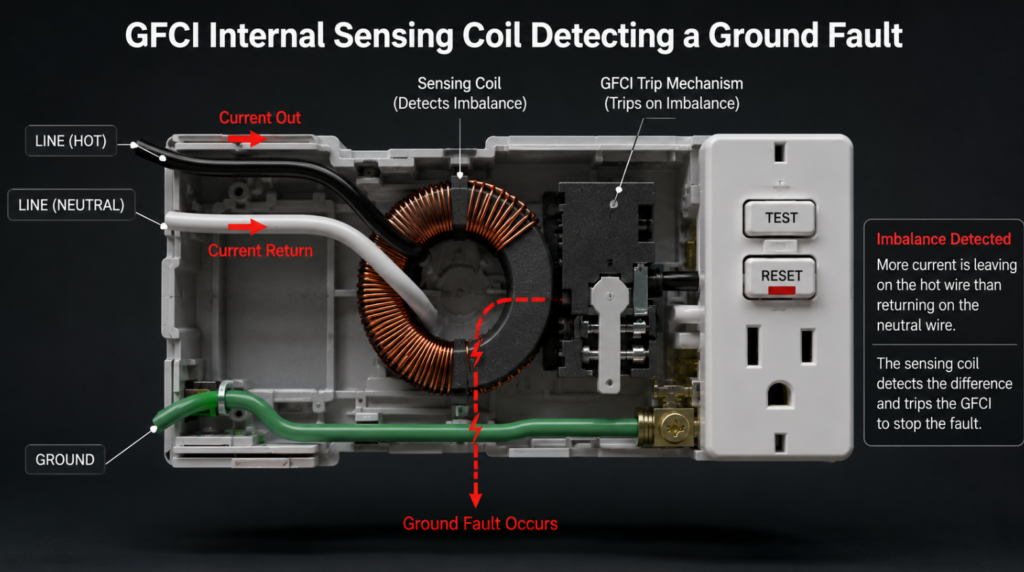
GFCI technology continuously compares the current flowing out of the hot wire with the current returning through the neutral wire. In a perfect circuit, these numbers match exactly. If a discrepancy of 4mA to 6mA occurs—meaning electricity has found an alternative path—the GFCI trips the internal relay in less than 25 milliseconds.
Standard utility power is “ground-referenced,” meaning the neutral is tied to the earth at the transformer. If you touch a live wire while standing on the ground, you complete the circuit. An isolation transformer uses a 1:1 magnetic coupling with no physical connection between the primary and secondary windings. The secondary side “floats”; since it has no reference to the earth, touching one of the output wires while standing on the ground will not result in a shock.
Most electricians rely on code books, but expert engineers use the R-P-S Framework to determine the superior safety choice for specific environments.
Understanding the technical nuances helps avoid costly installation errors that a standard “DIY guide” would miss.
| Performance Metric | GFCI (Ground Fault Circuit Interrupter) | Isolation Transformer |
|---|---|---|
| Trigger Mechanism | Detects current imbalance between hot and neutral conductors (typically 4–6 mA) and disconnects the circuit | Electrically isolates the primary and secondary circuits, preventing direct fault current paths |
| Response Time | Extremely fast, typically 20–30 ms | Passive protection with no active trip response |
| Noise Suppression | Minimal; not intended for filtering electrical noise | Excellent; significantly reduces common-mode noise and electrical interference |
| Cost | Low; generally $15–$50 per unit | High; typically $200–$2,000+, depending on power rating |
| Maintenance | Requires periodic testing using the TEST/RESET buttons | Minimal maintenance; occasional inspection for insulation integrity and overheating |
| Best Use Case | Personnel protection in bathrooms, kitchens, outdoor outlets, workshops, and wet environments | Sensitive medical equipment, laboratory instruments, industrial control systems, and noise-critical electronics |
A common mistake among DIYers is installing a GFCI on the output of an isolation transformer. Because the transformer’s secondary is floating, a standard GFCI’s “Test” button will not work, and the device may fail to detect a fault because there is no ground reference for the leak to follow.
Advanced safety engineers know that isolation transformers aren’t perfect at high frequencies. Due to “stray capacitance” between the primary and secondary windings, high-frequency noise or “leakage” can still pass through. This is why high-end medical transformers require a grounded “Faraday Shield” between the windings.
If you are running a Variable Frequency Drive, a standard GFCI will often “nuisance trip” due to the harmonic distortion and capacitive leakage of the motor cables. In these cases, an isolation transformer is often used to “clean” the power and isolate the noise floor, preventing the GFCI from seeing phantom faults.
In these sectors, ground fault circuit interrupter vs isolation transformer is not a competition but a hierarchy. Isolation transformers are mandated in many “wet” surgical areas because they allow for a “first fault” to occur without plunging the room into darkness, providing a warning via a Line Isolation Monitor.
Boats use isolation transformers to prevent galvanic corrosion. By isolating the boat’s electrical system from the shore power’s ground, you prevent the boat’s hull from becoming a sacrificial anode, which a GFCI cannot do.
“”TuPian ChaRu: Diagram showing how an isolation transformer prevents galvanic current from eating away a boat’s drive unit.””
Can an isolation transformer replace a GFCI for NEC compliance?
No. In most residential and construction applications, the National Electrical Code specifically requires GFCIs for personnel protection. An isolation transformer is a specialized tool and generally does not satisfy the legal requirement for “GFCI-protected outlets” in kitchens or bathrooms.
Does a GFCI protect the equipment or the person?
A GFCI is designed almost exclusively to protect humans from electrocution. It does nothing to protect your sensitive electronics from power surges, spikes, or electrical noise.
Does an isolation transformer protect against surges?
While it provides some degree of protection by physically separating the circuits, it is not a dedicated surge protector. However, it is excellent at filtering out “Common Mode Noise.”
Can I get a shock from an isolation transformer?
Yes. If you touch both output wires of the transformer simultaneously, you become the load. The transformer cannot distinguish you from a lightbulb, and it will not trip.
Why do GFCIs trip when nothing is plugged in?
This is often due to moisture in the junction box or “conductive dust” creating a path to ground that exceeds the 5mA threshold. In industrial areas, it can also be caused by long wire runs creating high capacitive leakage.
Master The DC Drive Isolation Transformer Definition And Wiki Facts To Prevent Costly Motor Failures.
View detailsAutotransformer Vs Isolation Transformer: 2026 Facts. Compare Voltage Stabilizers And Power Conditioners For B2B.
View detailsMaster Fuse Rating Of Distribution Transformer & Oltc Distribution. Use Our 3-Node Sizing Guide To Stop Trips.
View detailsHow To Test A Power Transformer And Tell If Yours Is Bad. Master Pro Multimeter Tests And Avoid Phantom Voltage.
View detailsPlease fill in the arithmetic result.
The calculation is incorrect, please fill it in again.