
 BBELC

Step up transformer for solar power plant: Sizing and fit
A step-up transformer for solar power plant (SOP) is located between the inverter or converter and the collector and grid-connected system. It is responsible for raising the voltage on the converter side to the voltage required for the collector line or grid-connected system. The project may involve a new energy box-type step-up transformer or a main transformer for the step-up station, and the specific equipment location depends on the electrical solution.
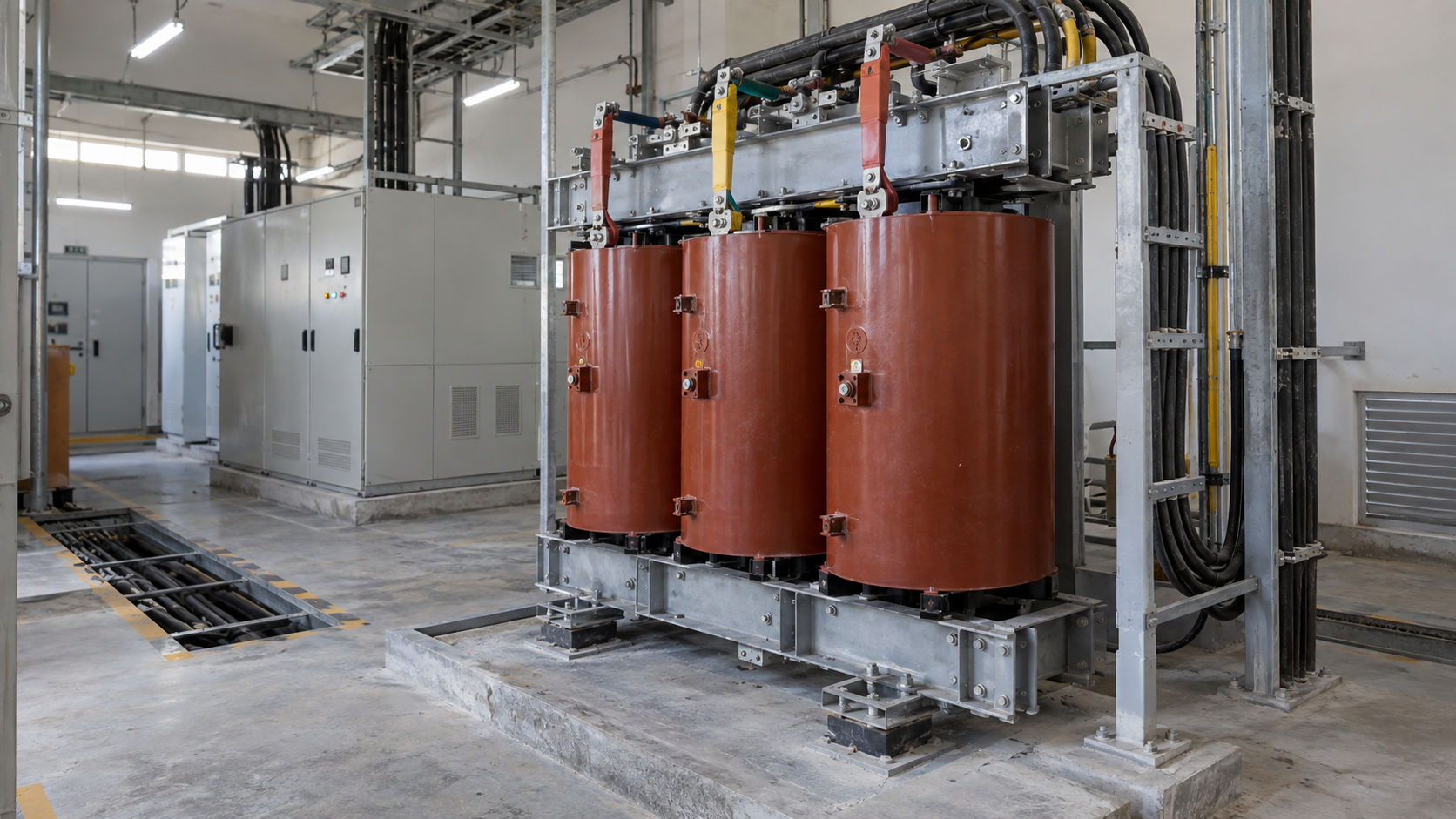
Boosting changes the voltage level and will not increase the power generation of the power station. At a given transmission power, increasing the line voltage can reduce the current, thereby reducing the line's I²R loss. The rated voltage on the secondary side is higher than that on the primary side, which is the basic characteristic of the boost relationship; the names of the primary and secondary sides should still be understood in conjunction with the project's markings on the high and low voltage sides and the actual power direction.
Capacity should correspond to the operating curve
Transformer nameplate capacity, expressed in kVA or MVA, is the apparent power rating under specified cooling, temperature rise, environmental, and frequency conditions. The three-correlation system is S=√3UI (U and I are the rated line voltage and line current, respectively). kW represents active power, which is not the same caliber as kVA; capacity determination also requires consideration of power factor, efficiency, and harmonic effects.
The inverter nameplate kW should not be directly added together as the transformer kVA selection value. Capacity should cover maximum continuous load, periodic load and short-term overload, and combine load growth, redundancy arrangement and cooling conditions. New energy projects also need to judge the number and capacity of converters, output voltage, reactive power operating range, daily cycle and grid connection requirements based on actual operating conditions.
The ratio change and the trend direction should be confirmed together
The ratio should be determined based on the actual power supply voltage range, target on-load voltage, and tap strategy; it cannot be determined by dividing only the two nominal voltages. Project information should indicate the input terminal, output terminal, high-voltage side, and low-voltage side respectively; if the system may experience reverse power flow, the normal and reverse power directions should also be stated to avoid interpreting the “primary side” fixed as the power input side.
Reverse power flow may affect the transformer's thermal state, voltage regulation logic, protection direction, fault current, and voltage quality. The rated kVA is the same, and it cannot be proven on its own that the equipment considered under one-way operating conditions meets the two-way operating conditions. It still needs to be evaluated in conjunction with the project operation method.
Harmonics and other adaptation conditions
Inverters are nonlinear loads, and harmonic currents will increase winding eddy current losses and other additional losses, affecting hot spots. Thermal capacity verification must be combined with the actual harmonic spectrum and load period. A general derating ratio cannot be applied to a single THD value; waveforms, peaks, and simultaneity are also relevant load characteristics.
The adaptation of photovoltaic and energy storage transformers also needs to consider the risk of DC magnetic deviation and reactive operating range. Only by considering these operating characteristics together with load conditions can we determine whether the equipment meets the project conditions.
Shanghai North Transformation's new energy dry transformer product range covers power conversion scenarios such as wind power, photovoltaics, and energy storage, and can use epoxy resin casting and segmented windings. The specific environmental level is subject to the project technical agreement; product category information alone cannot prove that a particular model is suitable for a specific photovoltaic boost section.