
 BBELC

Secondary Winding Of Distribution Transformer Explained
“secondary winding of distribution transformer” is not a coil named simply by voltage level. In contrast to the primary winding of distribution transformer, the primary winding is connected to the AC power supply during operation, while the secondary winding supplies power to the load. The primary and secondary directions first describe the energy input and output directions, so the secondary fixed cannot be directly understood as high pressure or low pressure.
Characters in the power distribution scene
Distribution transformers are located at the end of the power transmission chain near the user and mainly convert the distribution network voltage into a voltage that can be used by commercial, residential, public facilities or industrial loads. In a typical operating mode, the primary winding is connected to the upper-level distribution power supply, and the secondary winding is connected to the downstream load. When distributed generation is reverse transmission, the actual power direction may be opposite to the traditional direction, and the role of the winding cannot be understood solely by the power flow direction.
In a typical buck distribution configuration, the secondary rated voltage is lower than the primary rated voltage; this indicates its voltage relationship in the system and is not a fixed meaning of the term “secondary” itself.
The voltage relationship is determined by the number of turns and the direction of operation
In the same operating direction, when the number of secondary turns is less than one, it is a step-down operation, and when the number of secondary turns is more than one, it is a step-up operation. Ideally, the proportion of the secondary voltage increase corresponds to the proportion of the secondary current decrease, but the voltage increase does not mean that the output power or energy is amplified. The equipment remains limited by rated capacity, winding rated current, temperature rise, and insulation level.
The terminal voltage changes when loaded
The turns ratio determines the no-load voltage relationship. After the load is connected, the secondary terminal voltage will also be affected by the winding resistance, leakage resistance, load current and power factor. Therefore, the result obtained by the turns ratio cannot be regarded as the precise terminal voltage under all operating conditions.
When the load increases, the reverse magnetomotive force generated by the secondary current will cause the primary side to increase the current intake. When judging the actual voltage on the secondary side, the rated relationship and the load condition should be considered together, and cannot be based on just one turns ratio.
The connection method determines how the secondary side of the three phases is read
Three-phase distribution transformers are commonly connected in star and triangle configurations. The connection method affects the line voltage, phase voltage, line current, phase current, neutral point conditions, and zero-sequence current channel. The star side provides a neutral point, and the triangle — star is one of the common distribution connections, but not all distribution systems must adopt this connection method.
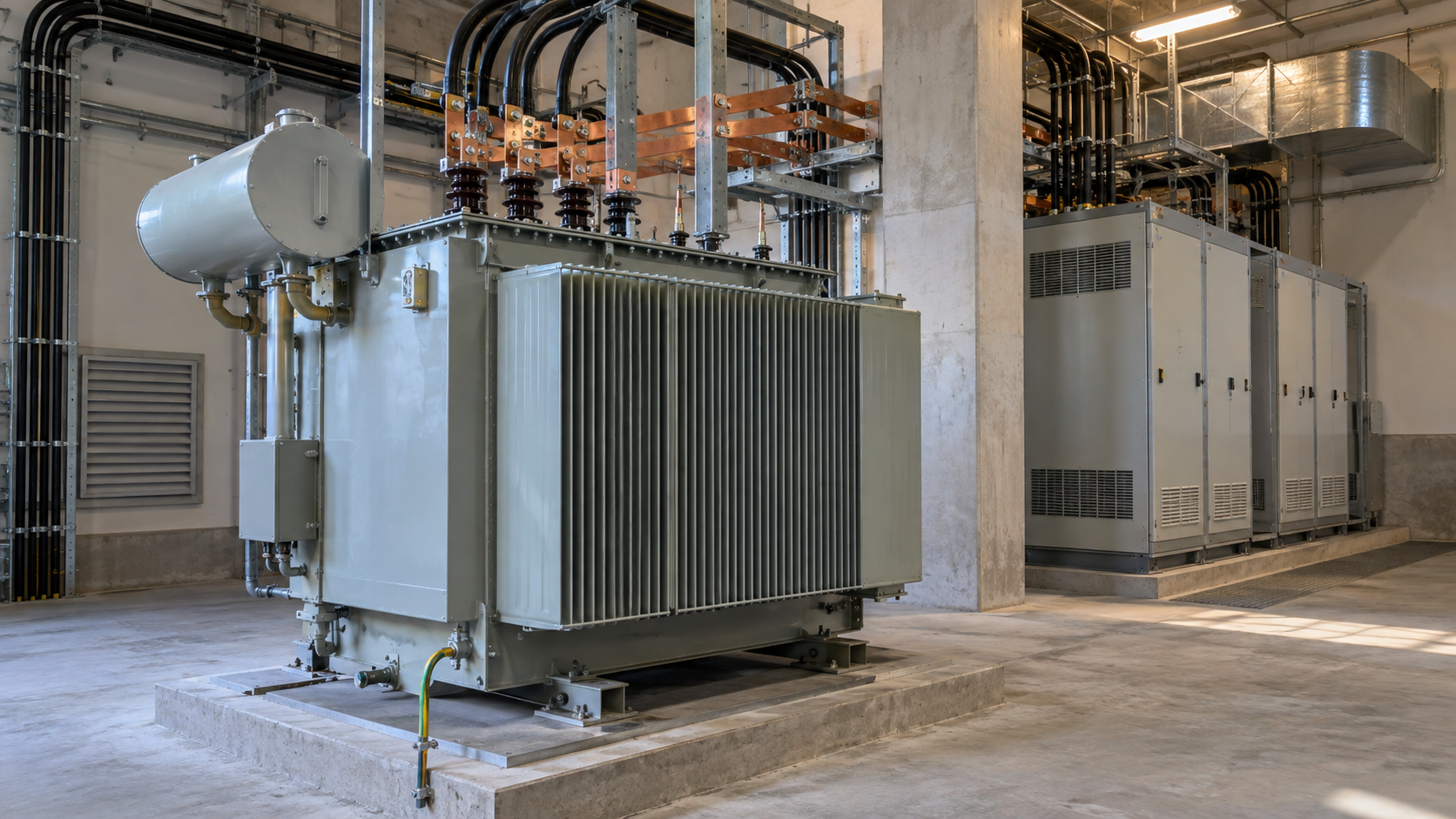
Therefore, the voltage data on the secondary side must also distinguish between line voltage and phase voltage and be understood in conjunction with the winding connection method; looking at only one voltage value cannot explain the complete three-phase connection conditions.
Isolation depends on whether the windings are independent
Distribution transformers with independent primary and secondary windings can provide electrical isolation simultaneously. If the primary and secondary windings of an autotransformer share a common portion, complete electrical isolation in the sense of a dual winding cannot be provided. The voltage role of the secondary winding and whether it is isolated are two different judgment dimensions.
When confirming the secondary winding, the energy direction, distribution system position, rated voltage, three-phase connection method and winding structure should be combined to determine.