
 BBELC

Resin-cast transformer: Choosing the Right Dry-Type Design
When it comes to “resin‑cast transformers,” don’t just focus on the word “resin” on the enclosure—understanding the insulation system used for the windings is what really matters. To put it plainly, this device is essentially a dry-type transformer; its core components are not immersed in insulating oil. Its biggest selling point is that the high-voltage winding is solidly cast into a single, solid coil using cured resin. The advantages of doing it this way are obvious: not only is it more durable and offers stronger mechanical support, but it also keeps moisture and dust out.
However, don’t be fooled by the word “casting” into thinking it’s just a completely sealed lump of iron. You should know that the low-voltage winding, the iron core, the lead wires, the terminal blocks, and even the cooling air ducts are all exposed. Therefore, when selecting equipment, you must ensure that ventilation, condensation prevention, dust protection, and sufficient maintenance access are all included—none of these can be omitted.
Don’t confuse resin casting with VPI.
When it comes to dry-type transformers, there’s a process called VPI (Vacuum Pressure Impregnation), which uses vacuuming and pressurization to forcefully “squeeze” insulating varnish or resin into the gaps of the windings, followed by baking to dry them; whereas in the most common open-type dry transformers, the windings are simply left exposed to the air. Although these three types are often collectively referred to as “dry-type,” when it comes to manufacturing processes, external protection capabilities, and their ability to withstand harsh environments, they differ vastly.
Take the dry-type products from Shanghai North Transformer as an example: different models come with varying configurations—insulation ratings include Class F and Class H—and manufacturing processes encompass both VPI (Vacuum Pressure Impregnation) and epoxy resin casting. When selecting a product, don’t automatically assume that because it’s a “dry-type product,” the entire series is resin-cast; and certainly don’t try to apply the specifications of a single model to the entire product line.
If the project places strict requirements on moisture resistance and mechanical strength, then there’s no choice—cast-in-place construction should definitely be prioritized. But if you’re looking to keep the weight down, stay within budget, or prioritize manufacturing flexibility, VPI might be a better fit for you. If you really want to compare performance, you must align all the key parameters—capacity, voltage, insulation class, temperature rise, cooling method, and operating environment—on a common baseline; nitpicking over names alone is entirely meaningless.
Environmental conditions cannot simply be labeled as “indoor.”
Resin‑cast dry‑type transformers are indeed very practical, especially in situations where oil leakage is a concern, proximity to the load center is required, or installation is confined indoors. However, this certainly does not mean you can completely disregard ventilation, fire safety, noise control, and maintenance access. Can it ultimately be installed in office buildings, hospitals, airports, data centers, or industrial plants? You need to consider the specific reliability requirements, the amount of space available on site, and compliance with local electrical codes.
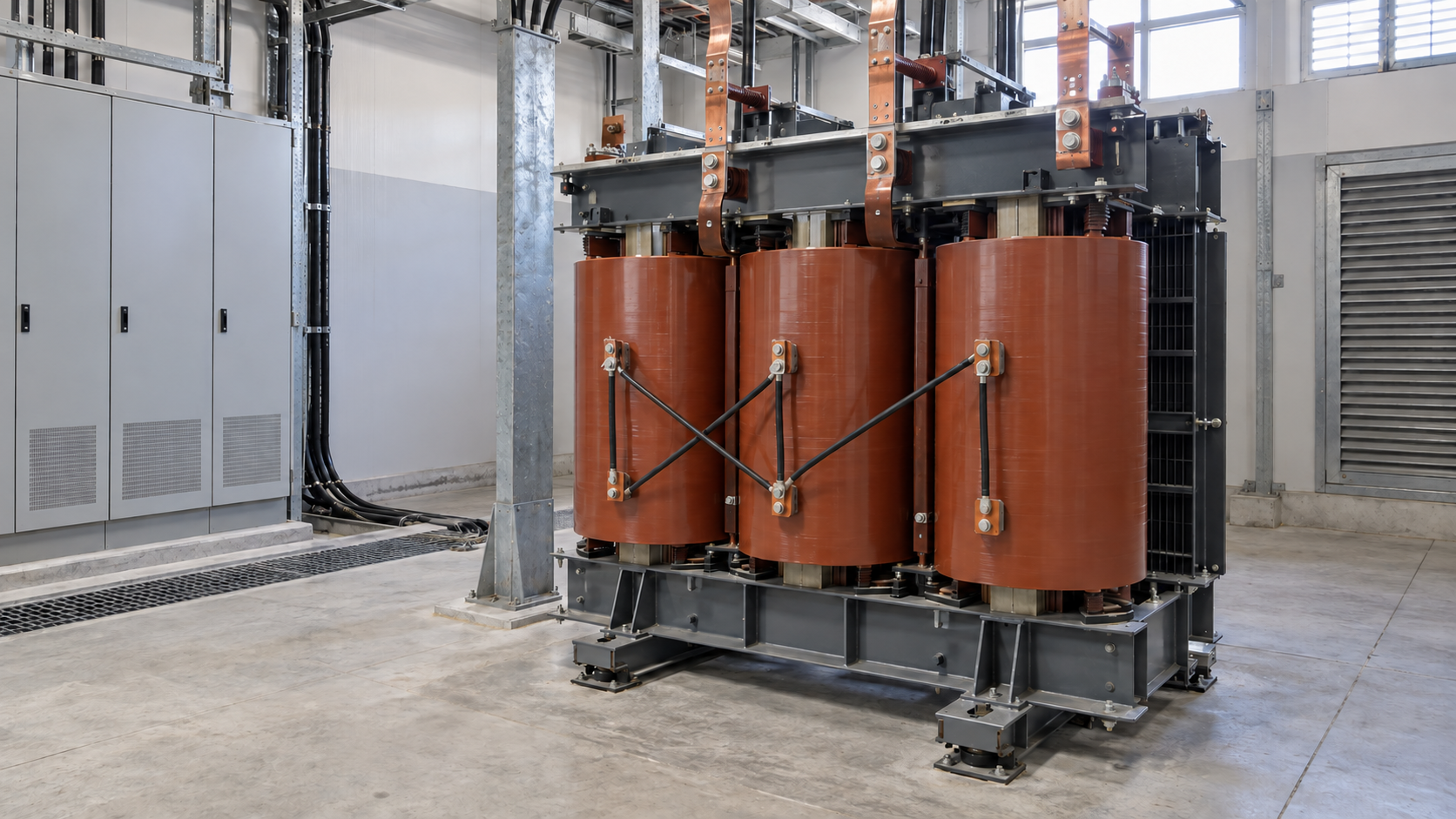
Perilous environmental hazards such as humidity, condensation, dust, salt spray, and chemical contamination must be systematically translated into stringent environmental performance criteria. Once the specifications are set, you can then decide which casting process to use, what type of mold to select, and how to perform future maintenance. Don’t assume that the “resin‑cast” label automatically grants a pass to withstand any harsh environment; nor should you blindly guess its fire resistance rating, outdoor protection capability, or capacity limits based solely on the material’s name. Once the case is installed, the airflow path is obstructed, and cooling performance will inevitably be compromised. Therefore, you should never rely solely on the bare‑bones factory test data when assessing the actual operating temperatures after assembly.
Also, just one more thing: in particularly humid or low-temperature environments, transformers are most prone to condensation during periods of inactivity or when they remain de-energized after maintenance. This matter must be addressed with a separate preventive measure. Just because it runs without issues when powered on under normal conditions doesn’t mean its insulation will remain in such good condition after being shut down for half a year.
The type of load it carries determines whether it can be used as a standard distribution transformer.
If the load connected downstream of the transformer is a nonlinear one—such as a variable-frequency drive, rectifier, inverter, or electric furnace—simply choosing a “resin‑cast” transformer will not suffice. Those chaotic current waveforms, runaway harmonics, and alarming peaks—combined with stringent requirements for impedance and short-circuit strength—will render conventional design standards completely obsolete. If you try to use a standard cast-resin dry-type distribution transformer to directly power converters, traction systems, or other specialized equipment, you’re bound to run into serious problems sooner or later.
When calculating capacity, you need to be more careful—don’t just mindlessly add up the nameplate ratings of all the equipment down below and call it a day. It is essential to first ensure that the primary and secondary side voltage, frequency, number of phases, grounding method, and permissible voltage deviation are all fully aligned. Then, based on the typical maximum normal load, the extent to which it can be overloaded for short periods, and the cooling method used, carefully calculate the rated values. To emphasize: Forced-air cooling with a fan and natural convection cooling can handle completely different thermal loads. In the event that the fan fails and shuts down, what is the maximum load the machine can still handle? This must be determined by data—never rely on guesswork or experience.
Don’t judge acceptance by appearance alone; robust electrical performance is what truly matters.
When the equipment is brought to the site, the first thing to check is its appearance: look for cracks, pits, or dents on the cast coil, make sure the terminal blocks are tightly fastened, and verify that the insulating spacers have not shifted. After the entire set of the enclosure and busbars is installed, you still need to double-check whether the air clearance is sufficient, whether the air ducts are blocked, whether the grounding complies with standards, and whether the terminal connections are properly stressed. Above all, be sure to leave enough space for maintenance. After all, once you add a bunch of messy on-site accessories, the original factory‑designed thermal and insulation boundaries are very likely to be altered. Before preparing to close the circuit breaker and energize the system, be sure to verify multiple times that the coil is clean and free from moisture, and that the temperature controller and fan are operating as expected.
Of course, visual inspection alone can never replace proper electrical testing with real equipment. The required tests—winding DC resistance, turns ratio, polarity, insulation resistance, as well as high‑voltage withstand, partial discharge, no‑load and load loss, and temperature rise tests—must all be performed in accordance with the relevant standards. It’s important to specifically address partial discharge testing here: if the manufacturer simply provides you with a pC value, it’s not very helpful. The assessment must be based on a comprehensive analysis of the applied voltage, the duration of the test, and the background noise at the site; a single, isolated value alone cannot adequately reflect the overall insulation condition.
Finally, a couple of words about daily operations and maintenance. Normally, keep a close eye on the winding temperature and the fan status, check for any hot spots at the terminals, listen for any abnormal “hissing” discharge sounds, and briefly inspect the condition of the resin surface. When cleaning, be careful with your technique—avoid damaging the resin surface, insulating components, and temperature sensors. If you do happen to discover cracks or signs of scorching and carbonization, never take chances by simply smearing some material over the surface and continuing to use it—this is absolutely a major no-no.
In short: whether a transformer is suitable or not cannot be judged solely by its name. All technical specifications must be rigorously validated against specific casting ranges, site conditions, load waveforms, thermal management parameters, and comprehensive test data.