
 BBELC

Fast Delivery Guide for Medium Voltage Dry Transformers
Many colleagues who are engaged in procurement or engineering, as soon as they hear the sales talk “medium-pressure drying can achieve fast delivery”, they immediately have a picture in their minds: there are ready-made goods in the warehouse, and a large car can drive over, load them and go. But this precisely ignores a most crucial premise. For a medium-voltage dry-type transformer to be truly “flash-shipped”, simply aligning the interfaces is far from enough. Design, material preparation, testing and logistics, can these invisible links really be lost? If you buy the device just to sell the one promised in your mouth “delivery days”, there is no guarantee that the thing will work reliably on the project after being pulled back.
Step 1: First, figure out whether the equipment is suitable for your project
Don’t think that the four words “medium pressure dry change” can encompass all the technical boundaries of the equipment. Rated voltage, capacity, frequency, impedance, connection group, as well as insulation grade, housing protection, environmental conditions and terminal interfaces… These hard indicators must be strictly aligned with the specific project. Especially for medium-voltage equipment, the maximum operating voltage, rated voltage, insulation level, local discharge requirements, and air clearance must be checked one by one. Don’t use the voltage parameters on the low-voltage side to fool the insulation requirements on the high-voltage side; it’s not the same thing at all. Comparing impedance is also a delicate matter: the reference capacity, reference temperature, tap position, and winding combination must be placed on a starting line. Otherwise, even if you look at the exact same percentage on the nameplates of the two devices and actually connect them to the system, the effect will definitely be 108,000 miles different.
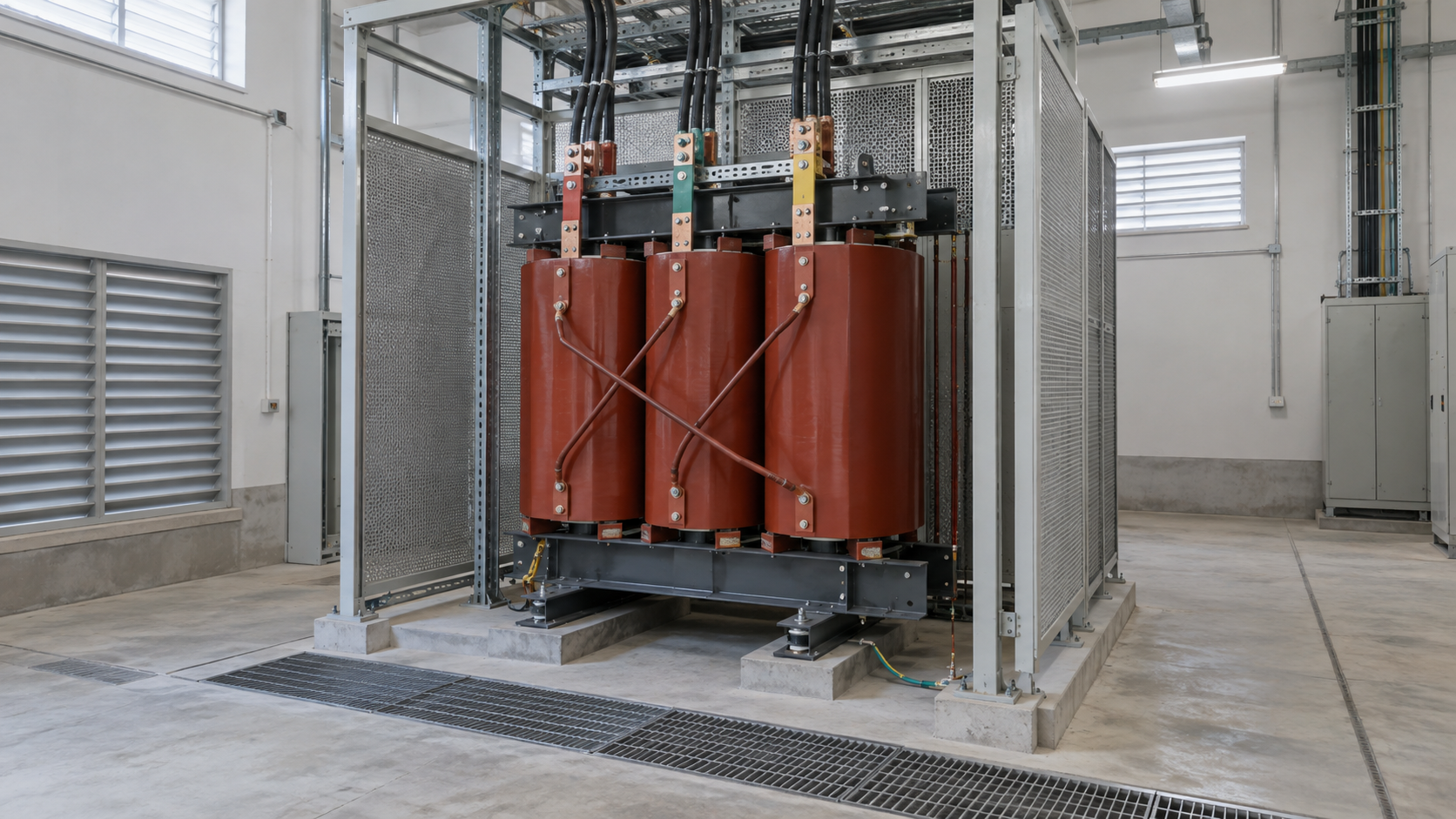
In addition, just talking about the “dry type”, the equipment structure is not explained clearly at all. Is it epoxy casting, encapsulation, VPI (vacuum pressure impregnation), or an open ventilated, non-ventilated, or fully sealed structure? The structures are different, and their ability to resist environmental damage, heat dissipation methods, and how troublesome they will be to repair later are all very different. Dry change can indeed rely on natural air cooling or forced air cooling, but the size of the fan must be calculated using solid rated data and temperature rise calculations. If the equipment is stored indoors, you still need to carefully calculate the heat dissipation loss, the operation of the intake and exhaust air systems, and whether there is enough room for the maintenance master to turn around and work. As for the humidity, condensation, dust, salt spray, corrosive gases, and even the altitude at the site, they must be honestly quantified into formal environmental parameters and must not be judged based on experience.
There is another big pit that is particularly easy to step on: if the rear end of the transformer is equipped with nonlinear and impactful “thorn head” loads such as rectifiers, frequency converters, and large motors, the technical protocol must clearly state the current waveform, harmonic spectrum, load period, and peak value. When calculating capacity, don’t be foolish enough to just add a piece of power to the nameplates of several devices and that’s it. You have to consider power, active power, power factor, efficiency, harmonics, and whether the equipment is rotating continuously or working intermittently, all in one dimension and make comprehensive calculations.
Step 2: Poke the filter to verify the true “delivery ready” status
The one in the sales mouth “can be sent at any time”, it really doesn’t mean that this transformer has been built and is so simple to put there. Is there a hiccup in the design baseline? Have you received the materials with a long delivery period? Are the key attachments ready? Even the production line schedule, whether the test bench is empty or not, where the drawings have been approved, and whether the packaging and logistics channels are smooth or not, all of these can be added together to determine when the equipment will be able to leave the factory. If the project uses standard interfaces and conventional configurations that have been approved in advance, it can indeed save a lot of time of repeated tearing and design. However, if your project is special, such as non-standard impedance, ultra-low noise, classification society certification requirements, special anti-corrosion coating, or very stuck size restrictions, then it is not right and you will most likely have to call the engineering department to review it again You can’t get up quickly if you want.
As for those that look like ready-made “stock machines”, you need to be more careful. Check when it was manufactured? In what environment do we usually stay? Are test reports and certification documents required and completed? On what day does the warranty period begin? Have any design changes been made in the middle? The most fatal thing is—— do I need to pull it back and redo the test? Just because it lies quietly on the inventory list doesn’t mean it can be loaded directly into the car and left. Especially for dry transformers, you have to go through the ground over and over again to check whether the environment they were in before and the field environment you want to stuff them into in the future can match the technical boundaries set at the time.
Step 3: Delivery time must be closely linked to shipping conditions
The tempting phrase “fast delivery” on the supplier’s quotation must be closely linked to the specific equipment model and quantity. When exactly will the train be allowed to depart? What prerequisites do drawings and experiments satisfy? Where will the goods arrive? What kind of logistics? When is the quote valid? All of this must be written in black and white in the contract. To prevent problems before they occur, we must also put the ugly words ahead in advance: in case any preconditions are not met on time, how should the delivery period be recalculated. Otherwise, no matter how loud the slogan “spot shipment in seconds” is, it cannot guarantee that the equipment will actually meet the shipping conditions before your node.
The transportation process must be implemented in a more practical way: How long, wide and high is the equipment in total? Multiple? Where is the center of gravity? How are the lifting points distributed? How much force is on the foundation? How to take the transportation route? Is the entrance passage wide enough? These hard indicators must be aligned with the packaging plan and the on-site delivery plan. Don’t wait for the indoor transformer to be towed to the scene with great effort, only to find that the space for air intake, exhaust and maintenance is simply not enough; let alone wait until the equipment has been installed on the road before you remember to confirm the technical requirements for special environments or nonlinear loads. By then, the daylilies were cold.
Ultimately, the only true measure of “fast delivery” is that all three components-technical parameters, delivery readiness status, and shipping conditions-must be finalized at the same point in time. As long as there’s even one item written here “to be confirmed”, then the so-called “fast delivery” is nothing more than a bad check. It neither proves that the equipment is suitable for your project nor is it a practical delivery plan at all.