
 BBELC

Power Transformer Recycling: Assess Before Dismantling
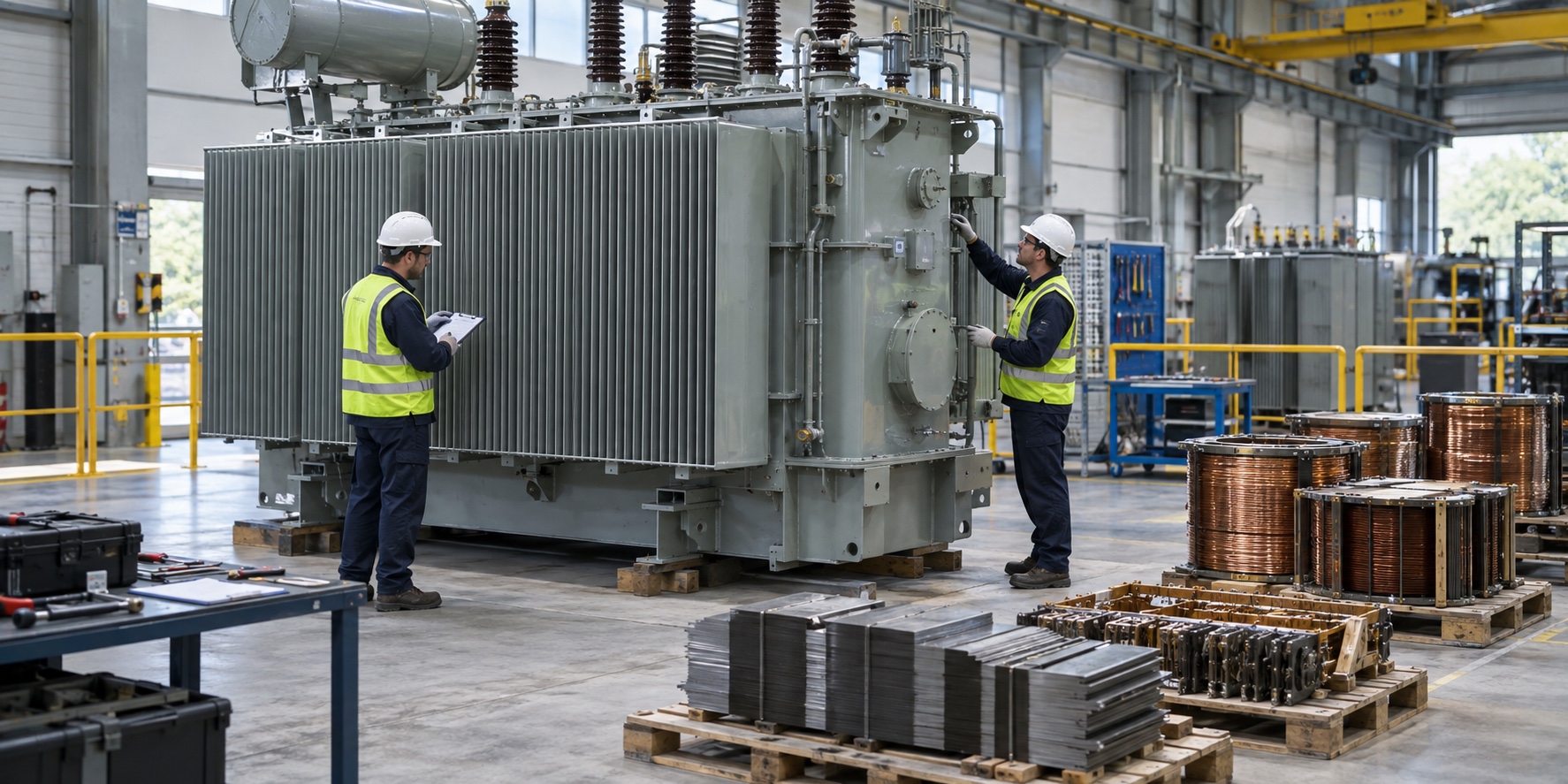
Recycling doesn’t start with dismantling.
Power transformer recycling should not start with weighing, dismantling copper or asking for scrap prices, but should first determine what technical value remains of the equipment. After the protective action, abnormal gas, pressure release, obvious deformation or casing damage occurs, the equipment should be isolated and the event record should be kept. It is not possible to judge whether it can still operate by repeated test delivery. External short circuit may also cause the winding axial or radial displacement, even if the DC resistance is temporarily normal, can not be ruled out mechanical damage.
Before proceeding to the disassembly phase, the equipment must undergo at least one boundary-based condition assessment. The assessment results may indicate continued operation, enhanced monitoring, localized repairs, rewinding, a comprehensive overhaul, or replacement. Only when these pathways are compared within the same technical and economic framework does recycling become a manageable asset decision, rather than a mere waste disposal operation.
First, determine whether to repair or exit the operation.
A single abnormality is not sufficient to directly determine that the entire transformer should be scrapped. The winding DC resistance can be used to check the connection, conductor or contact changes, the ratio and phase relationship can check the winding and connection status, and the insulation resistance can reflect the cleaning, moisture or deterioration trend, but these results need to be combined with reference, phase comparison, historical record and other test interpretation.
For liquid immersion equipment, the condition evaluation can also combine the dielectric properties of the insulating liquid, water content, dissolved gas, sleeve, tap changer and thermal imaging results. For dry-type equipment, particular attention should be paid to its appearance, cleanliness, connections, infrared temperature, insulation, partial discharge, and cooling control. If the equipment has experienced transportation impact or external short circuit, frequency response, short circuit impedance and other checks can assist in determining whether the winding or mechanical structure has changed, but can not rely on a curve to make a conclusion.
The scope of maintenance should be determined by the failure mechanism. Sealing, bushings, cooling systems, tap changers, lead connections, insulation, and windings each correspond to different repair tasks. Rewinding will change the number of turns, conductor, insulation, geometry, impedance, temperature rise and short circuit mechanical strength, so it is necessary to form a controlled design and complete electrical, mechanical, sealing, cooling and protection verification according to the scope of influence after repair. Simply obtaining a “normal resistance” result is not sufficient to prove that the equipment has regained its rated performance.
Establish a traceable record of dismantling decisions.
Before commencing the formal disassembly, the equipment’s identity, structure, and condition should be thoroughly documented. Nameplate information, model, capacity, windings, voltage, tap positions, frequency, connection group, operational history, protection events, maintenance records, and historical test data constitute the foundation for determining the subsequent course of action. Test records should also include information on the instruments, wiring, tap positions, environmental conditions, and dates, so that data from different stages are comparable.
This step also prevents the direct interchange of components that appear identical. Even if they share the same name, bushings, tap changers, cooling components, instruments, and protective devices may still be incompatible in terms of dimensions, insulation, electric fields, control systems, and interfaces. Components intended for reuse must have their origin, condition, and compatibility boundaries verified; decisions should not be based solely on visual integrity or approximate model numbers.
The value of materials must be accounted for together with the associated disposal responsibilities.
A transformer may contain copper or aluminum conductors, electrical steel, insulating materials, insulating liquid, bushings, tap changers, cooling equipment, and structural components. The recyclability, disassembly complexity, and processing requirements vary depending on the material. The value of recovery is affected by a combination of copper, aluminum, electrical steel, insulating fluids, dismantling work, and hazardous material compliance costs, so it is easy to overlook the real costs and risks by valuing the entire device as ordinary scrap metal before testing.
In particular, liquid immersion equipment needs to identify the type of insulating liquid and the substances that may be regulated, and then determine the detection, storage, transportation and disposal methods according to the regulations of the equipment location. The rules of a particular country or region cannot directly replace the requirements of the project's location. At the site, leakage, mixed loading, and loss of source identification should also be avoided to ensure traceability in material recovery and environmental responsibility.
Relatively complete life-cycle cost
Maintenance costs and the purchase price of new equipment are only part of the decision-making process. Downtime losses, temporary power supply, transportation, on-site disassembly and assembly, remaining accessory life, energy efficiency, test capacity, re-failure consequences, and the foundation, bus bars, cables, protection settings and fire protection modifications of new equipment may all change the final choice.
It is more prudent to establish separate scenarios for continuing operations, enhanced monitoring, partial maintenance, rewinding, complete refurbishment, replacement and material recovery, and to document the technical risks and economic assumptions for each scenario. in this way, power transformer recycling to connect security isolation, state judgment, value retention and compliance disposal into a complete path, and also enable maintenance, reuse and material recovery to occur within the boundaries of sufficient evidence.