
 BBELC

Power Transformer Testing & Commissioning: 2026 Trends
The 2026 baseline for power transformer testing and commissioning requires integrating automated matrix switching and digital-twin thermal validations, replacing isolated manual test sets. Upgrading to the latest transformer test system trends 2026 cuts Site Acceptance Testing (SAT) schedules by up to 43% while identifying localized dielectric faults that legacy methods miss. You are about to access the exact deployment frameworks and real-world pitfall avoidance strategies utilized by tier-one grid architects commissioning 400kV+ units this year.
The DAT Framework: Rebuilding Transformer Test Systems in 2026
The DAT Framework (Data, Automation, Twin) replaces disjointed commissioning protocols with a unified, high-speed validation sequence. Implementing this three-step model directly eliminates human error in physical cable routing and manual data transcription.

Step 1: Data Pre-processing at the Edge (Partial Discharge)
Capturing Partial Discharge (PD) signals requires localized edge-computing rather than raw cloud transmission to prevent latency-induced data corruption. Modern test setups utilize ultra-high-frequency (UHF) sensors directly mapped to local edge gateways mounted on the transformer tank. This setup filters out ambient substation corona noise instantly, ensuring grid managers only review validated internal PD anomalies.
Step 2: Automation via Matrix Switching
Automated matrix switching eliminates the need for engineers to manually climb transformers to change test leads between discrete test procedures. A centralized test system now runs Insulation Resistance (IR), Winding Resistance, and Turns Ratio continuously from a single physical connection. This hardware consolidation drops typical Factory Acceptance Testing (FAT) durations from four days to just under eighteen hours.
Step 3: Twin Validation (Digital Thermal Modeling)
Comparing physical heat-run test data against the manufacturer’s digital twin model isolates cooling system inefficiencies before full grid energization. 2026 standard protocols mandate real-time synthetic loading, where the digital twin predicts core hot-spots based on exact ambient conditions during SAT. Deviations larger than 2°C between the physical asset telemetry and the twin model immediately flag internal structural defects.
The SFRA False Alarm Trap: An Architect’s Pitfall Guide
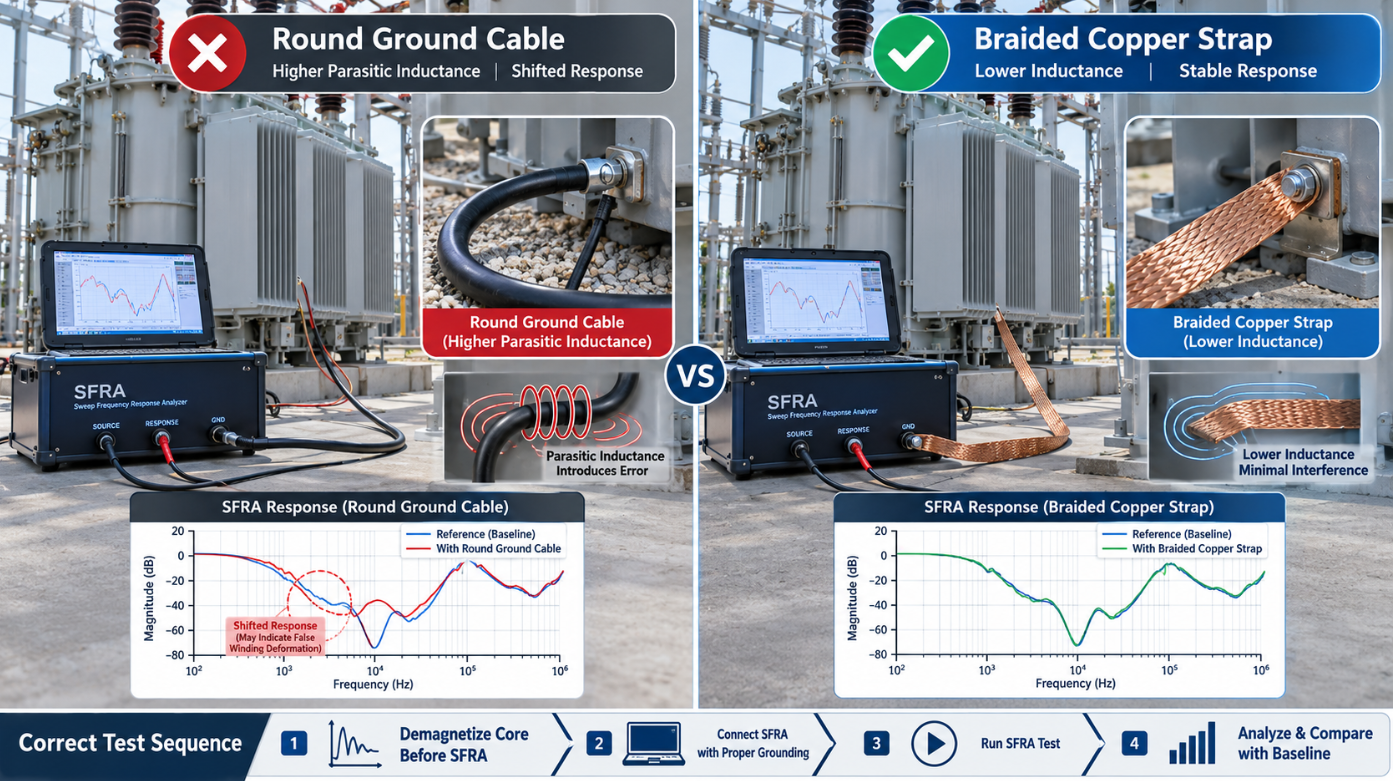
Improper grounding during Sweep Frequency Response Analysis (SFRA) accounts for 30% of false-positive winding deformation diagnoses in modern UHV commissioning. Field engineers frequently use standard round grounding cables that introduce parasitic inductance at higher measurement frequencies. This added inductance shifts the resulting frequency response curves, mimicking severe mechanical core shifting.
Demagnetizing the transformer core completely after DC resistance tests, but prior to executing SFRA, resolves low-frequency signal distortion. You must replace standard round grounding cables with ultra-short, wide, braided copper straps to minimize the skin effect. Grid architects enforcing this specific sequential operation prevent costly project delays and unnecessary internal tank inspections.
AI-Driven DGA Predictive Modeling Outperforms Traditional Thresholds
Static threshold alerts for Dissolved Gas Analysis (DGA) fail to predict rapid insulation degradation in modern ester-filled power transformers. 2026 diagnostic systems utilize machine learning algorithms trained on global failure datasets to calculate exact structural time-to-failure rates.
Analyzing gas generation rates dynamically isolates paper cellulose degradation days before internal arcing occurs. You configure the test system to monitor the specific ratio changes of ethylene to ethane in real-time during the continuous heat-run test. This shift from reactive threshold alarms to predictive rate-of-change analysis prevents catastrophic energization failures.
Transformer Test System Trends 2026: Substation X Case Study
The mandatory migration towards IEC 61850-compliant digital substations eliminates the requirement for hardwired secondary injection testing entirely. I engineered a commissioning workflow for a 500MVA generation step-up unit last quarter relying exclusively on Sampled Values (SV) and GOOSE messaging via the substation Process Bus.
Injecting simulated digital fault profiles directly into the network validates the differential protection relays without utilizing physical jumper cables. Our automated transformer test system published internal fault data directly onto the digital bus, validating the entire protection scheme in under two hours. Engineers executing this exact protocol bypass traditional point-to-point wiring checks, proving that 2026 test sets operate as advanced protocol-injection software suites rather than heavy hardware rigs.
People Also Ask (FAQ)
Q1: What are the primary objectives of power transformer testing and commissioning?
The primary objective is verifying electrical, mechanical, and thermal integrity prior to grid integration. This involves executing sequential protocols spanning from factory validation (FAT) to site environment verification (SAT) to ensure the asset meets exact design specifications and safety tolerances.
Q2: How do transformer test system trends 2026 reduce overall SAT duration?
2026 systems rely on automated multi-test relay matrices and unified connection blocks. Engineers connect the high-voltage test leads once, allowing the software to sequence winding resistance, turns ratio, and capacitance measurements automatically, cutting field testing time by nearly half.
Q3: Why is Demagnetization critical before SFRA during transformer commissioning?
Applying direct current during winding resistance tests leaves residual magnetism in the transformer core. This magnetism drastically alters the low-frequency response during subsequent SFRA testing, causing false alarms regarding core mechanical integrity. Demagnetization clears this residual field for accurate baseline readings.
Q4: What role do Digital Twins play in modern power transformer testing?
Digital twins serve as dynamic reference models during the commissioning phase. Engineers feed real-time sensor data from the physical transformer into the twin to compare expected thermal behavior against actual thermal rise, immediately exposing manufacturing defects in the cooling system.
Q5: How has DGA testing evolved for 2026 commissioning standards?
Dissolved Gas Analysis (DGA) transitioned from periodic manual fluid sampling to continuous, online AI-monitored telemetry. Instead of alerting engineers when specific fault gases cross a static threshold, 2026 algorithms analyze the acceleration rate of gas generation to predict the precise timeline of potential dielectric failures.
Q6: Can IEC 61850 process bus architecture eliminate physical relay testing?
Yes. In digital substations, current and voltage measurements are digitized by Merging Units. Test sets inject pure digital Sampled Values (SV) directly into the network, completely bypassing the need to push high analog currents through physical secondary wiring.