 BBELC
BBELC
How Does Isolation Transformer Work? Coupling Facts
31How Does Isolation Transformer Work? Discover How They Are Coupled, Magnetic Facts, And Pro Engineering Tips.
View details
Search the whole station
The baseline power transformer life expectancy ranges strictly from 25 to 40 years, but its actual operational mortality is dictated entirely by the degradation of its internal cellulose paper insulation. Routine power transformer operation and maintenance protocols directly govern this aging process by controlling the continuous hot-spot temperature and moisture ingress. Once the cellulose paper’s Degree of Polymerization (DP) drops below 200, the transformer reaches its absolute end-of-life and will fail catastrophically under the next grid short-circuit event. Asset management directors can defer multi-million dollar CAPEX replacements by decades utilizing the chemical diagnostics, dynamic thermal management frameworks, and proactive dehydration strategies detailed below.
Reliability engineers fail when they treat transformer maintenance as a calendar-based checklist rather than a condition-based chemical intervention. Implementing the L.I.F.E. framework translates daily engineering telemetry directly into verifiable asset longevity and financial depreciation control.
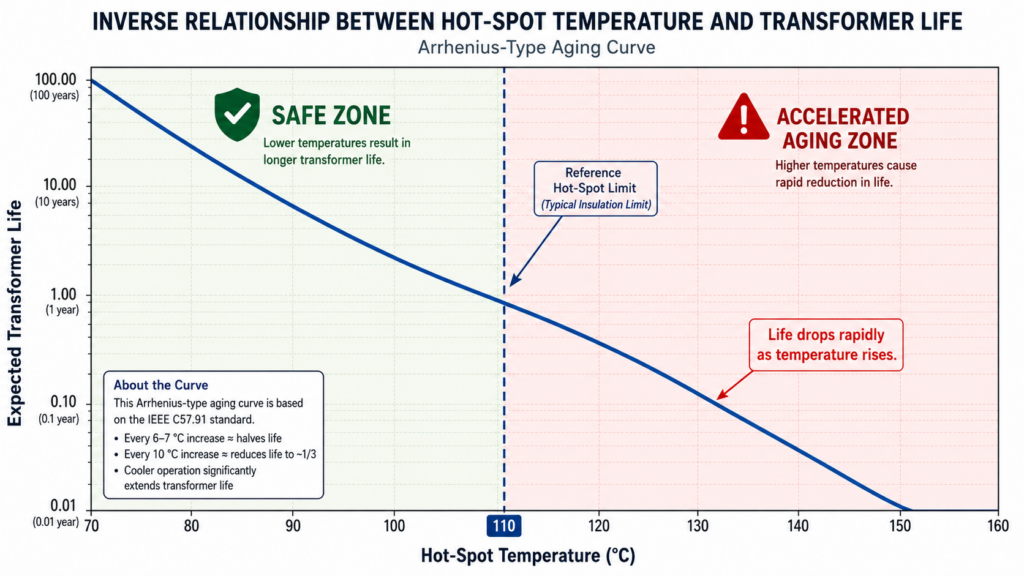
Thermal stress irreversibly destroys cellulose insulation. The Arrhenius equation dictates that every 10°C increase in the winding hot-spot temperature above the 98°C baseline halves the remaining power transformer life expectancy. Strategic power transformer operation requires operators to dynamically shift loads across parallel units during peak summer demands, ensuring no single asset sustains a hot-spot temperature exceeding 110°C for more than 4 consecutive hours.
Moisture acts as an aggressive catalyst for insulation decay. Water content within the cellulose doubling from 1.5% to 3.0% reduces the transformer’s mechanical life by exactly 50%. Standard oil filtration only removes moisture from the fluid. Effective maintenance requires deploying online molecular sieve dehydration systems that continuously extract trapped water directly from the solid cellulose paper while the transformer remains energized.
You cannot measure paper degradation visually without dismantling the entire active part. As cellulose breaks down, it releases specific chemical byproducts called furanic compounds into the insulating oil. Measuring the concentration of 2-Furfuraldehyde (2-FAL) via High-Performance Liquid Chromatography (HPLC) provides an exact mathematical correlation to the remaining DP value. A 2-FAL concentration hitting 5.0 mg/L signals an immediate red alert for impending mechanical collapse.
The On-Load Tap Changer (OLTC) causes 40% of all transformer failures due to its moving mechanical parts. Best practices mandate upgrading older oil-switching OLTCs to vacuum-interrupter technology. Vacuum technology eliminates oil carbonization entirely, extending the maintenance interval from 50,000 operations to over 300,000 operations, drastically reducing OPEX.
Plant managers frequently destroy perfectly healthy transformers by misapplying forced cooling protocols during cold weather operations. Avoid the static electrification trap to prevent self-inflicted insulation failure.
Operators logically assume that cooler temperatures extend power transformer life expectancy. During winter operations, some reliability teams force oil pumps to run continuously (OFAF mode) even when the transformer carries a light load. Cold insulating oil possesses high viscosity. Pumping highly viscous oil aggressively through the narrow cellulose ducts creates massive fluid friction. This friction strips electrons from the paper, generating a high-voltage static charge within the oil flow. When this static charge exceeds the dielectric strength of the surrounding fluid, it discharges as a massive internal lightning strike, instantly destroying the transformer. You must interlock your oil pump PLC controls to the top-oil temperature, ensuring pumps only activate when the oil viscosity drops to safe operational levels.
Shifting from time-based maintenance to predictive intervention requires integrating real-time chemical and electrical sensors directly into your SCADA architecture.
Annual Dissolved Gas Analysis (DGA) sampling leaves the asset blind for 364 days. Intermittent faults, such as localized micro-arcing, can generate explosive levels of acetylene (C2H2) in under a month. Advanced power transformer operation dictates installing multi-gas online DGA monitors directly on the cooling valves. These sensors provide continuous, real-time ppm tracking, allowing asset managers to detect active cellulose degradation or core overheating the exact moment it begins.
Operating a highly loaded transformer accelerates oil oxidation. Oxidation generates sludge and organic acids that aggressively attack the copper windings and cellulose. You must track the oil’s Neutralization Number. Once the acid value exceeds 0.15 mg KOH/g, standard maintenance practices fail. You must execute an oil reclamation process utilizing Fuller’s earth filters to chemically neutralize the acid before it causes irreversible sludging within the radiator fins.
| Diagnostic Metric | Healthy Range | Action Required Range | End-of-Life Threshold |
| DP Value | > 400 | 200 – 400 | < 200 |
| 2-FAL Level | < 2.5 mg/L | 2.5 – 4.9 mg/L | ≥ 5.0 mg/L |
| Moisture Content | < 1.5% | 1.5% – 3.0% | > 3.0% |
| Acid Number | < 0.10 mg KOH/g | 0.10 – 0.15 mg KOH/g | > 0.15 mg KOH/g |
Traditional power transformer operation relies on static IEEE loading guides, heavily restricting the asset’s capacity based on conservative nameplate ratings. Grid operators in 2026 utilize Dynamic Digital Twin Load Rating (DDTLR) to push assets harder without burning their lifespan.
Engineers embed fiber-optic temperature sensors directly into the winding spacers during manufacturing. This hardware feeds exact, real-time thermal data into a cloud-based AI digital twin. The software calculates the exact thermal inertia of the oil mass and the ambient weather conditions. The digital twin informs the dispatch center exactly how long they can run the transformer at a 120% overload (e.g., to support sudden EV charging demands) before the cellulose reaches 110°C. This dynamic operation safely extracts maximum revenue from the asset without sacrificing a single day of its expected life.
A regional utility planned to scrap a critical 50 MVA, 115kV transmission transformer operating in its 32nd year. The initial oil tests showed moisture content at a critical 3.5%, and the estimated DP value hovered dangerously around 350. The finance department had already allocated $4 million for CAPEX replacement.
Our reliability engineering team intervened with an aggressive life-extension protocol. We installed a continuous online molecular sieve dehydration system without taking the unit offline. Over 18 months, the system safely extracted 45 liters of water from the solid cellulose, dropping the internal moisture to 1.2%. Concurrently, we performed an oil reclamation to neutralize the acidity and installed an online multi-gas DGA monitor to track operational safety.
The Financial Result: The drying process halted the cellulose degradation entirely. The transformer successfully passed all mechanical short-circuit strength evaluations. The utility officially extended the asset’s power transformer life expectancy by 12 years, successfully deferring the $4 million capital expenditure and reallocating those funds to urgent smart-grid upgrades.
A well-maintained power transformer operates reliably for 40 to 50 years. However, its absolute lifespan ends when the cellulose paper insulation’s Degree of Polymerization (DP) drops below 200. At this point, the paper becomes incredibly brittle and will shatter under the mechanical stress of a routine grid fault.
Operation dictates the internal thermal stress. The core rule of transformer aging is the 10°C rule: running the transformer’s hot-spot temperature 10°C above its design limit (usually 98°C to 110°C) cuts its remaining life expectancy exactly in half. Smart load balancing is the most effective life-extension tool.
Routine maintenance involves checking oil levels, inspecting for leaks, and testing cooling fans. Life-extension maintenance involves chemical interventions, such as online cellulose dehydration, oil reclamation (acid neutralization), and vacuum tap-changer retrofits, which actively reverse or halt the degradation of the asset.
Engineers test the insulating oil for a chemical called 2-Furfuraldehyde (2-FAL). Cellulose paper releases this furanic compound exclusively as it decays. By measuring the ppm concentration of 2-FAL in the oil, engineers use logarithmic formulas to calculate the paper’s remaining DP value, accurately predicting the remaining years of service.
Moisture acts as a catalyst for depolymerization. Water breaks the chemical bonds of the cellulose paper, drastically accelerating thermal aging. Furthermore, sudden temperature spikes can cause moisture trapped in the paper to instantly boil into vapor bubbles, severely compromising the oil’s dielectric strength and causing an immediate internal flashover.
You cannot reset the lifespan of the original cellulose paper. However, a factory rewind (replacing the copper coils and all solid insulation) essentially creates a brand-new active part. If the core steel and external tank remain in excellent condition, rewinding costs approximately 60% of a new unit and resets the operational life expectancy to year zero.
How Does Isolation Transformer Work? Discover How They Are Coupled, Magnetic Facts, And Pro Engineering Tips.
View detailsMaster The Exact Electrical Symbol For Galvanic Isolation Using Transformer To Stop High Frequency Layout Failures
View detailsPower Transformer Ratings Explained: Decode The Math. Master KVA Formulas, The V-I-T Matrix, And Avoid KW Traps.
View detailsPower Transformer Type Test: Learn How To Check Performance, Audit Factory Data, And Avoid Hidden Defects.
View detailsPlease fill in the arithmetic result.
The calculation is incorrect, please fill it in again.