 BBELC
BBELC
Power Transformer Inspection, Maintenance And Testing SOP
7Master Power Transformer Inspection, Maintenance And Testing SOP To Detect Internal Arcing And Prevent Grid Failures.
View details
Search the whole station
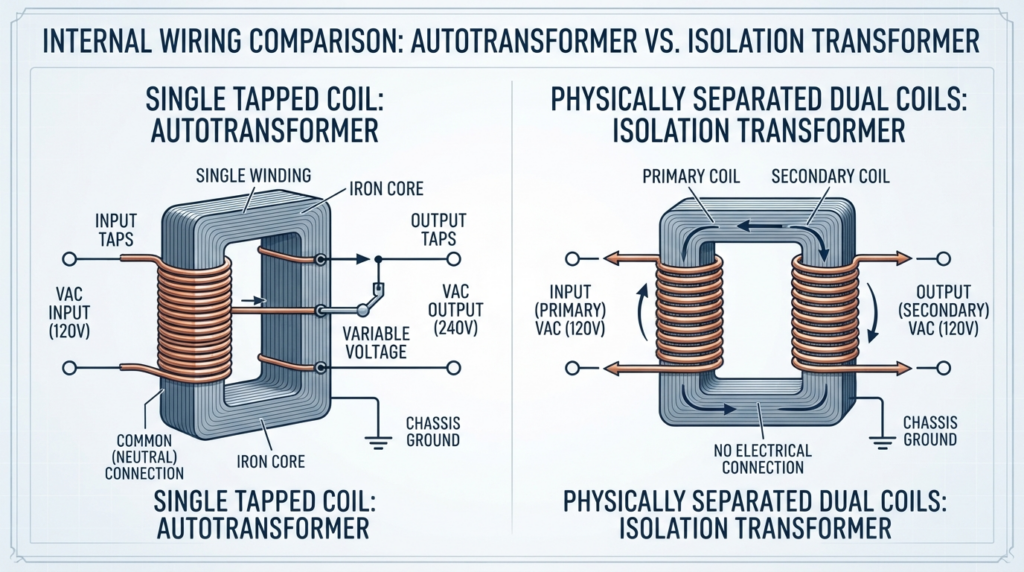
You cannot use an autotransformer for electrical isolation. Autotransformers share a single, continuous winding for both the primary and secondary connections, meaning the input and output are electrically tied together. This direct pathway provides zero galvanic isolation. If you use an autotransformer expecting a safety barrier, any fault on the secondary side will pass raw mains voltage directly into your equipment or your body.
You also cannot grab just any random step-down or step-up transformer off the shelf and use it as an isolation transformer. True isolation requires distinct, physically separated primary and secondary coils with specific dielectric ratings. Many DIY hardware modders learn this the hard way when their expensive oscilloscope vaporizes upon touching a circuit powered by a standard variable transformer. Let’s break down exactly how to verify true galvanic separation, identify the specific types of isolation transformers, and test your hardware before plugging it in.
A Variac is a variable autotransformer, not an isolation transformer. Junior electrical engineers frequently make the critical error of plugging a switch-mode power supply into a Variac to perform load testing. They attach the ground clip of their oscilloscope probe to the primary side of the SMPS. Because the Variac provides no isolation and the oscilloscope ground clip is tied to earth ground through the wall socket, this action creates an immediate dead short across the mains power line.
The result is a blown main breaker, vaporized PCB traces, and a destroyed oscilloscope. Autotransformers exist purely for efficient voltage regulation within a small footprint. They save copper and reduce core size by stacking the primary and secondary voltages on the same coil. They offer zero protection against ground loops or electrical shock.
No. Only transformers built specifically with galvanic separation between the input and output windings function as isolation transformers. Standard commercial transformers often lack the necessary inter-winding shielding or dielectric strength required to block high-voltage transients.
A standard 1:1 voltage ratio does not automatically guarantee safety isolation. Manufacturers on cheap e-commerce platforms frequently label standard 120V-to-120V transformers as “isolation” devices, yet internally bridge the neutral wires to save manufacturing costs. Relying on a label without bench testing puts your hardware at severe risk.
Never trust the manufacturer’s datasheet blindly. Apply the 3-Step D.I.T. (Disconnect, Inspect, Test) framework using a digital multimeter (DMM) to verify true isolation before applying power.
Engineers categorize different types of isolation transformers based on their core geometry, shielding methods, and specific application frequencies.
Toroidal isolation transformers use a donut-shaped magnetic core. This circular geometry traps the magnetic flux entirely within the core, preventing electromagnetic interference (EMI) from leaking into nearby sensitive electronics.
Audio engineers rely on toroidal isolation to eliminate 60Hz ground loop hum in amplifier stacks. Medical facilities use specialized medical-grade toroidal transformers built to the strict IEC 60601-1 standard. These medical units feature an ultra-low leakage current (often below 100 microamps) and a dedicated Faraday shield between the windings to divert stray capacitance to the ground.
| Transformer Type | Leakage Current | EMI Shielding | Cost |
| Medical Grade | Ultra-Low (Often below 100 microamps to meet strict IEC 60601-1 safety standards) | Advanced (Features a dedicated Faraday shield between windings to divert stray capacitance to ground) | Highest (Premium pricing due to rigorous safety certifications, testing, and specialized construction) |
| Audio Grade | Standard / Moderate (Sufficient for standard equipment safety, but not rated for direct patient contact) | High (Toroidal geometry traps magnetic flux entirely within the core to eliminate 60Hz ground loop hum) | Moderate to High (Priced higher than standard due to custom winding techniques and high-quality core materials) |
| Standard Control | Standard Industrial (Typically much higher than medical grade, often up to 3.5 milliamps or more) | Basic (Standard galvanic isolation; lacks dedicated Faraday shields or specialized EMI trapping geometry) | Lowest (Cost-effective and mass-produced for general-purpose industrial and commercial applications) |
Split-bobbin designs place the primary and secondary coils side-by-side on a divided plastic former, rather than wrapping one coil directly over the other. This physical separation inherently provides high dielectric strength and minimizes capacitive coupling between the input and output. Industrial control panels use split-bobbin isolation transformers to step down 480V factory power to a safe 120V or 24V control circuit, completely isolating the sensitive PLCs (Programmable Logic Controllers) from heavy motor noise.
Pulse transformers provide isolation for high-frequency digital signals rather than raw AC mains power. You will find tiny pulse transformers inside Ethernet jacks (often called magnetics) or gate drive circuits for MOSFETs. They transfer square wave pulses across an isolation barrier at megahertz frequencies, protecting delicate microcontrollers from the high-voltage spikes generated by heavy switching loads.
When a dedicated isolation transformer is unavailable, hardware modders wire two identical step-down transformers back-to-back. You connect the 120V mains to the primary of the first transformer, which steps the voltage down to 12V. You then connect that 12V output into the 12V secondary of the second transformer, which steps it back up to 120V. Because the power passes through two separate magnetic gaps, you achieve full galvanic isolation. This method introduces significant efficiency losses but serves as a highly effective, low-cost safety barrier for bench testing small electronics.
You expose yourself and your equipment to raw mains voltage. Any fault on the secondary side provides a direct path to earth ground, leading to severe electric shock, tripped breakers, and destroyed circuitry.
No. A Variac is a variable autotransformer. It uses a single coil with a movable wiper to adjust voltage. The input and output share the same electrical pathway, offering zero isolation.
Use a digital multimeter set to continuity mode. Probe between the primary terminals and the secondary terminals. If the multimeter beeps or shows a resistance value, it is not an isolation transformer. It must read “OL”.
No. A 1:1 ratio simply means the output voltage matches the input voltage. If the manufacturer tied the neutral lines together internally, the transformer provides no isolation despite the 1:1 ratio.
Medical isolation transformers meet strict IEC 60601-1 safety standards. They feature reinforced insulation, internal Faraday shields, and restrict leakage currents to extremely low levels to protect patients connected to medical monitoring equipment.
No. Microwave Oven Transformers operate as step-up transformers with the secondary coil directly tied to the metal chassis. Using them for bench isolation is highly lethal.
Master Power Transformer Inspection, Maintenance And Testing SOP To Detect Internal Arcing And Prevent Grid Failures.
View detailsDiscover How Isolation Transformers Prevent Macroshock Vs GFCI. Compare Power Continuity And Medical Device Safety.
View detailsDoes A Transformer Always Draw Power? Learn How Much Power Does A Transformer Consume When Idle And Avoid Energy Loss.
View detailsHow Do Power Transformers Work? Master Output Rating Metrics And The Isolation Transformer Symbol For Smart Sizing.
View detailsPlease fill in the arithmetic result.
The calculation is incorrect, please fill it in again.